Project Overview & Direct Cost Answer
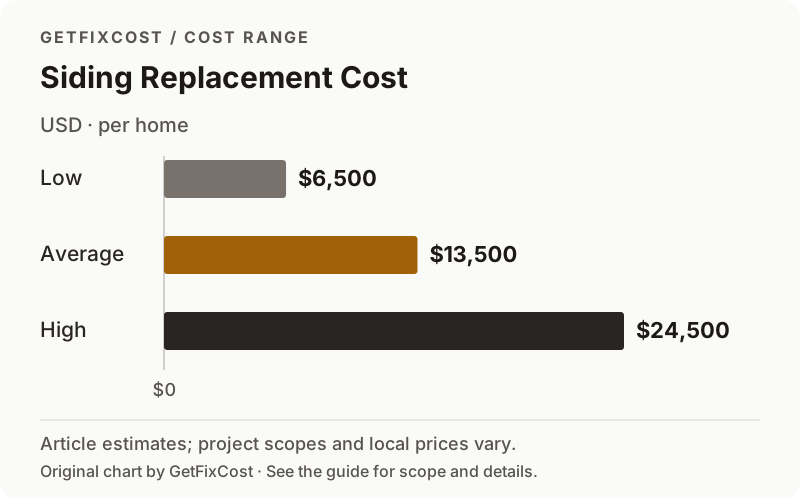
Replacing the exterior siding on a single-family home in the United States typically costs between $6,500 and $24,500, with the national average centering at $13,500 for an average 2,000 square foot two-story home (approx. 1,800 to 2,200 square feet of exterior wall surface).
Budget-friendly vinyl siding installations on simple single-story homes can cost as little as $6,500 to $9,500 ($3.50 to $7.00 per square foot installed). Conversely, premium installations using James Hardie fiber cement, insulated vinyl, or natural cedar shake on multi-story homes with complex architectural gables range from $15,000 to $32,000 ($8.00 to $16.00 per square foot).
Siding serves as your home’s primary protective envelope against wind-driven rain, insect infestation, and seasonal thermal loss. Residing your home completely refreshes exterior curb appeal, lowers heating and cooling bills when combined with modern rigid foam insulation, and historically yields a 68% to 75% return on investment in property resale value.
Quick-Reference Cost Table
| Siding Material | Cost Per Sq Ft Installed | Typical Cost (2,000 Sq Ft Wall Area) | Expected Lifespan | Primary Benefit |
|---|---|---|---|---|
| Standard Vinyl Siding | $3.50 – $7.50 | $7,000 – $15,000 | 20 – 30 Years | Most affordable, low maintenance, zero paint needed |
| Insulated Vinyl Siding | $5.50 – $10.50 | $11,000 – $21,000 | 25 – 35 Years | Enhanced impact resistance, added R-value insulation |
| Fiber Cement (James Hardie) | $8.00 – $14.50 | $16,000 – $29,000 | 30 – 50 Years | Non-combustible, authentic wood look, termite-proof |
| Engineered Wood (LP SmartSide) | $7.00 – $12.50 | $14,000 – $25,000 | 25 – 35 Years | Impact resistant, lightweight, easier installation |
| Natural Cedar Shakes | $10.00 – $19.00 | $20,000 – $38,000 | 25 – 40 Years | Timeless rustic aesthetic, requires periodic sealing |
Cost Factors That Impact Total Pricing
Several physical and logistical variables influence your siding replacement estimate:
- Exterior Wall Square Footage: Siding contractors calculate estimates by “siding squares” (100 square feet of wall area). Deducting window and door openings from your home’s total wall footprint determines the required material squares.
- Old Siding Removal & Disposal: Stripping away old vinyl, aluminum, or cedar siding and hauling it to a disposal facility costs roughly $1.00 to $2.25 per square foot. If old siding contains lead paint or asbestos tiles, specialized environmental abatement fees apply.
- Sub-Wall Sheathing & Rot Repair: Once old siding is stripped, carpenters inspect the underlying OSB or plywood sheathing for water rot caused by failed flashing. Replacing damaged sheathing adds $75 to $120 per 4x8 sheet.
- House Wrap & Rigid Foam Insulation: Installing high-performance breathable weather barriers (like Tyvek HomeWrap) and taped seams is mandatory. Adding 1/2-inch to 1-inch continuous exterior rigid foam insulation adds $1.50 to $3.00 per square foot but substantially reduces thermal bridging.
- Trim, Soffits, and Fascia Detailing: Upgrading window casings, door surrounds, corner posts, and aluminum or vinyl soffit/fascia overhangs represents roughly 25% to 35% of total project labor costs.
Regional Cost Variations Across the US
Geographic labor rates and climate requirements shape siding pricing:
- Pacific Northwest & West Coast: High carpenter wages ($90–$140/hr) and strict moisture management standards (mandatory rainscreen drainage mats) place averages at $14,500 to $26,000.
- Northeast: Older colonial architecture, dense neighborhoods, and freeze-thaw cycles raise average fiber cement and vinyl jobs to $13,500 to $24,000.
- Midwest: Abundant skilled installer competition and straightforward two-story suburban architecture keep average costs around $10,500 to $18,500.
- Southeast & Texas: Lower baseline labor costs keep vinyl siding replacements around $9,000 to $15,500, though coastal hurricane zones require reinforced nail-hem patterns and heavy-gauge panels.
Repair vs. Replace: How to Decide
Determine whether targeted siding repairs or full replacement is warranted:
- When to Repair: If damage is confined to a single wall or isolated panels (such as melted vinyl near a barbecue grill, lawnmower rock holes, or loose wind-damaged strips) and the surrounding siding is under 15 years old, professional repairs costing $350 to $1,200 are ideal.
- When to Replace: If your siding exhibits widespread waviness, brittle cracking across multiple elevations, dry rot along the bottom three courses, or faded, chalky oxidation that cannot be matched, full replacement is necessary.
- The 50% Rule: If the cost to replace rotten lap sections, re-nail loose courses, and repaint faded siding exceeds half the price of a full residing project, choose replacement to renew weatherproofing and curb appeal.
DIY vs. Hiring a Professional & Safety Warnings
While handy homeowners can replace a single cracked vinyl panel with a specialized zip tool, residing an entire multi-story house is rarely a realistic DIY endeavor.
Improperly installed siding causes catastrophic hidden moisture damage. Siding is designed as a rainscreen, not a waterproof submarine hull; water naturally gets behind siding and must drain safely down weather-resistant barriers and out flashing weep holes. Nailing vinyl siding too tightly prevents natural thermal expansion, causing panels to buckle and warp in summer heat.
Furthermore, working on scaffolding and 28-foot extension ladders while maneuvering 12-foot siding planks poses serious fall hazards. Professional siding crews work efficiently with pump-jack scaffolding, pneumatic siding coil nailers, and brake presses to custom-bend aluminum trim on-site.
Warning Signs You Need Action Immediately
Inspect your home exterior for these definitive symptoms of siding failure:
- Warped, Buckled, or Wavy Panels: Indicates either improper tight nailing during installation or underlying structural wall movement.
- Cracked or Missing Siding Pieces: Gaps allow wind-driven rainwater to penetrate directly to OSB sheathing and wall cavity insulation.
- Peeling Interior Paint or Wallpaper: Moisture penetrating through failed siding flashing frequently manifests inside the house as bubbling drywall paint or musty odors.
- Fungus, Mold, or Mildew Along Seams: Persistent biological growth along siding laps indicates water is trapped behind the cladding and cannot drain.
- Insect or Woodpecker Holes: Rotting wood lap siding attracts termites, carpenter ants, and woodpeckers seeking insect larvae.
Hidden Costs & Contractor Pitfalls
Scrutinize contractor quotes for these commonly overlooked expenses:
- Window and Door Flashing Tape: Properly integrating self-adhering flashing tape around window frames prevents wall leaks. Skipping this step leads to expensive interior repairs down the road.
- Soffit and Fascia Replacement: If your overhang fascia boards are rotten, new siding cannot be secured cleanly without replacing the fascia at $15 to $30 per linear foot.
- Exterior Fixture Remounting: Removing and remounting outdoor lighting, hose bibbs, electrical outlets, and satellite dishes onto dedicated J-blocks adds $200 to $500.
- Dumpster & Haul-Away Fees: Confirm whether roll-off dumpster rental and disposal fees ($400 to $800) are included in your quote.
How to Save Money and Vet Contractors
Maximize your home exterior investment with these proven strategies:
- Obtain Three Detailed Proposals: Insist that every siding contractor specifies the exact manufacturer (CertainTeed, Mastic, James Hardie), profile thickness (.044” or .046” premium vinyl vs .040” builder-grade), and underlayment brand.
- Inquire About Factory-Finished Colors: Products like James Hardie with ColorPlus Technology carry 15-year paint finish warranties, saving you the immediate expense of painting bare primed boards.
- Verify James Hardie Alliance Status: If installing fiber cement, choose a contractor certified through the James Hardie Contractor Alliance program to guarantee adherence to strict installation instructions.
- Time Your Project in Late Fall: Late autumn siding installations often qualify for off-season labor discounts from contractors looking to maintain full work crews.
Typical Project Timeline & Process
A full residential siding replacement typically takes 1 to 2 weeks:
- Phase 1: Delivery & Scaffolding Setup (Day 1): Materials are delivered and crews erect pump-jack scaffolding and ladders around the home perimeter.
- Phase 2: Tear-Off & Sheathing Inspection (Days 2 to 3): Old cladding is stripped, damaged plywood sheathing is replaced, and new breathable house wrap is installed with taped seams.
- Phase 3: Flashing & Trim Installation (Days 4 to 6): Custom metal corner posts, window drip caps, and starter strips are fastened in place.
- Phase 4: Siding Field Installation (Days 7 to 10): Siding courses are nailed in place from the bottom up, maintaining proper expansion clearances.
- Phase 5: Caulking & Final Cleanup (Day 11): High-grade elastomeric sealant is applied around trim transitions, scaffolding is dismantled, and magnetic sweeps clear the yard of nails. ze.
- Will insurance cover siding replacement? Homeowners insurance covers sudden damage from storms, hail, or falling trees, but excludes normal aging or neglect.
Next Steps & Estimate Checklist
Take these practical steps before meeting with siding contractors:
- Measure your home’s exterior perimeter and approximate wall heights to calculate rough square footage.
- Decide on preferred cladding materials (vinyl, fiber cement, or engineered wood) and color palettes.
- Solicit three comprehensive written estimates from licensed, insured local siding contractors.
Frequently Asked Questions
01. How much does it cost to reside a 2,000 square foot house?
02. What is the most affordable siding material?
03. Is James Hardie fiber cement worth the extra cost?
04. How long does new siding last?
05. Can you install new siding over old siding?
Related Cost Guides
More in this trade →
Exterior House Painting Cost
Understand exterior house painting costs per square foot, including prep work, materials, and regional labor variations.
Gutter Replacement Cost
Get realistic gutter replacement costs for aluminum, copper, and vinyl systems, including fascia repairs and downspouts.
Window Replacement Cost
Get realistic window replacement costs per window, including double-hung, casement, and bay window options.