Project Overview & Direct Cost Answer
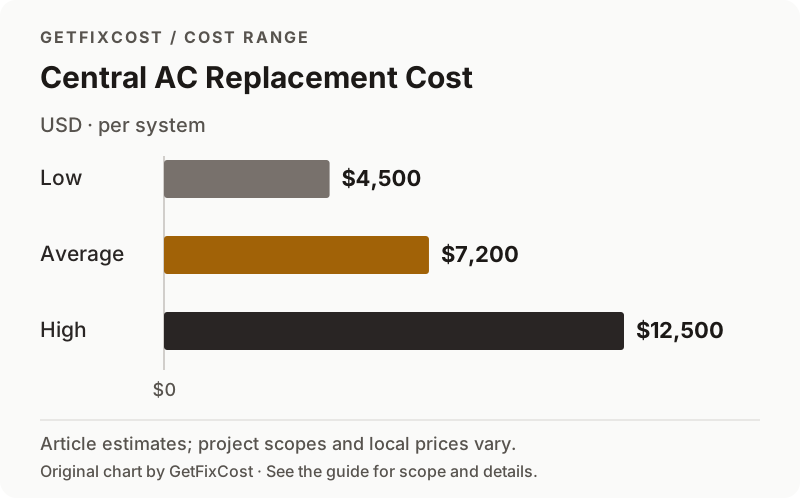
Replacing a central air conditioning system in the United States typically costs between $4,500 and $12,500, with the national average centering at $7,200 for a standard 3-ton, 15.2 SEER2 split-system condenser and matching evaporator coil installed by a licensed HVAC contractor.
Budget installations for smaller two-ton systems in mild climates using single-stage technology start around $3,800 to $4,800. Conversely, large four- to five-ton variable-speed inverter systems with extensive ductwork modifications can reach $11,000 to $16,500. Replacing both your central air conditioner and gas furnace simultaneously as a matched system typically costs between $8,500 and $17,000.
Equipment accounts for 45% to 55% of the total estimate, while specialized technician labor, refrigerant evacuation, electrical connections, and municipal permitting comprise the remainder. Licensed HVAC contractors generally charge between $90 and $175 per hour, with most standard residential split-system changeouts requiring 8 to 14 total labor hours.
Quick-Reference Cost Table
| System Size (Tonnage) | Home Square Footage | Standard 14.3–15.2 SEER2 | High-Efficiency 16–18 SEER2 | Premium 19+ SEER2 Variable Speed |
|---|---|---|---|---|
| 2.0 Tons | 1,000 – 1,300 Sq Ft | $3,800 – $5,200 | $5,000 – $6,800 | $7,500 – $10,000 |
| 2.5 Tons | 1,300 – 1,600 Sq Ft | $4,400 – $6,000 | $5,600 – $7,600 | $8,200 – $11,200 |
| 3.0 Tons | 1,600 – 2,000 Sq Ft | $5,200 – $7,200 | $6,400 – $8,800 | $9,200 – $12,800 |
| 3.5 Tons | 2,000 – 2,400 Sq Ft | $5,800 – $8,100 | $7,200 – $9,800 | $10,200 – $14,000 |
| 4.0 – 5.0 Tons | 2,400 – 3,200+ Sq Ft | $6,800 – $9,600 | $8,400 – $11,500 | $11,500 – $16,500 |
Primary Factors Affecting Price
Several technical parameters dictate where your quote falls within the national cost spectrum:
- System Tonnage & Manual J Sizing: Air conditioning capacity is measured in tons (1 ton = 12,000 BTUs of heat removal per hour). Proper sizing requires an ACCA Manual J load calculation factoring in home orientation, window glazing, insulation, and ceiling height. Oversized units short-cycle and fail to dehumidify, while undersized units run constantly without cooling.
- Compressor Technology: Single-stage compressors operate at 100% capacity whenever called. Two-stage units run at 65% capacity on moderate days, costing $1,200 to $2,200 more but improving humidity control. Modulating variable-speed inverter compressors adjust continuously between 25% and 100%, adding $3,000 to $5,500 for whisper-quiet comfort.
- Refrigerant Line-Set Condition: If your existing copper refrigerant lines are damaged, contaminated, or undersized, a new line set must be pulled through finished walls or attics, adding $400 to $1,200.
- Electrical Service & Disconnect Box: Modern building codes require an outdoor electrical disconnect box within sight of the condensing unit, along with a dedicated 240V circuit breaker. Replacing an old disconnect box, outdoor whip, and surge protector adds $250 to $500.
- Ductwork Modifications: When a new indoor cased evaporator coil is mounted on an existing furnace, custom sheet metal plenum transitions must be fabricated on-site to ensure leak-free airflow, adding $300 to $800.
Regional Cost Variations Across the US
Geographic climate zones and regional labor rates directly affect equipment requirements and installation overhead:
- Southeast & Deep South (Florida, Texas, Louisiana): Subtropical humidity and extended 8-month cooling seasons demand high-efficiency systems with advanced dehumidification. High contractor competition balances labor, with typical 3-ton systems installed for $6,200 to $9,500.
- Southwest (Arizona, Nevada, Southern California): Extreme dry heat with summer temperatures exceeding 110°F requires heavy-duty compressors capable of operating in brutal ambient conditions, placing averages between $7,000 and $11,000.
- Northeast (New York, Pennsylvania, New England): Tight older basements, union labor wage structures, and municipal permitting push average installation costs to $7,500 to $12,000.
- Midwest (Ohio, Illinois, Missouri): Balanced 4-season climates keep baseline replacement expenses moderate, centering around $5,800 to $8,500 for standard efficiency split systems.
Repair vs. Replace: Making the Right Call
Homeowners should apply the industry-standard $5,000 Rule when weighing an expensive repair against system replacement:
- The $5,000 Rule of Thumb: Multiply the age of your central AC in years by the contractor’s repair quote in dollars. If the resulting figure exceeds $5,000, replacement is financially superior. For example, a $1,200 repair on an 8-year-old system ($1,200 x 8 = $9,600) clearly indicates that money should be redirected toward a new replacement unit with an active 10-year warranty.
- When to Repair: If your system is under 8 to 10 years old, under warranty, and needs a basic external component—such as a capacitor, contactor switch, or outdoor fan motor—a repair costing $175 to $600 is reasonable.
- When to Replace: If your system has suffered a burned-out compressor, has extensive refrigerant leaks in an aging evaporator coil, or still runs on obsolete R-22 Freon, investing thousands into a dying system is a costly mistake.
DIY vs. Hiring a Professional
Central air conditioning replacement is strictly prohibited as a DIY project under federal environmental law.
Under Section 608 of the US Clean Air Act, it is a federal offense for uncertified individuals to purchase, handle, recover, or release regulated refrigerants into the atmosphere. Installing a central AC requires thousands of dollars in specialized technical tools, including recovery cylinders, a high-vacuum pump, manifold digital gauges, nitrogen tanks, and oxy-acetylene torches.
Furthermore, improper refrigerant charging destroys compressor efficiency, spikes utility bills, and leads to premature mechanical failure within two to three seasons. Licensed HVAC contractors pull required permits and provide workmanship guarantees in addition to 10-year manufacturer equipment warranties.
Warning Signs You Need Action Now
Watch for these clear operational indicators that your central air conditioner is nearing terminal failure:
- Warm Air at Registers: If the compressor runs continuously but supply air feels lukewarm, your system has likely developed a refrigerant leak or suffered internal compressor valve degradation.
- Ice Accumulation on Lines: Frozen evaporator coils or frost coating the outdoor copper line indicate severe airflow restriction or a dangerous drop in refrigerant pressure.
- Grinding or Squealing Noises: Harsh mechanical noises from the outdoor condenser signal failing compressor bearings or bent fan blades.
- Unexplained Utility Spikes: As compressors and coil surfaces degrade, the system must run longer and draw significantly higher amperage to deliver the same cooling output.
Hidden Costs and Common Pitfalls
Review your HVAC estimates carefully to avoid common surprise expenses:
- Thermostat Incompatibility: Upgrading to a two-stage or modulating variable-speed inverter system usually requires a communicating smart thermostat or running a new multi-conductor thermostat wire, adding $250 to $600.
- Condensate Drainage and Safety Float Switches: Codes mandate emergency secondary drain pans and float shut-off switches for indoor evaporator coils installed in attics. If your drain line clogs, the float switch shuts off the AC before water leaks through your ceiling, adding $150 to $300.
- Return Air Duct Deficits: High-efficiency modern systems require greater airflow volume than older units. Undersized return air grilles may require cutting in an additional return duct, adding $400 to $900.
How to Save Money and Get Fair Quotes
Protect your investment by using these contractor vetting and bidding strategies:
- Demand a Manual J Calculation: Never hire a contractor who sizes your new system solely based on square footage. Insist on seeing their Manual J heating and cooling load calculation.
- Utilize Federal 25C Tax Credits: Under the Inflation Reduction Act, high-efficiency central air conditioners meeting CEE highest tier standards qualify for a federal tax credit of up to $600, while qualifying heat pumps earn up to $2,000.
- Get Three Itemized Bids: Require quotes that detail exact model numbers for both outdoor condenser and indoor evaporator coil, AHRI certificate numbers, SEER2 ratings, and labor warranty coverage.
- Avoid Peak Summer Replacements: If your cooling system is struggling in spring, replace it before July. HVAC contractors charge premium rates during heatwaves, whereas spring scheduling offers greater negotiating room and promotional equipment rebates.
Typical Project Timeline
Knowing what to expect during installation ensures minimal household disruption:
- Phase 1: In-Home Assessment & Sizing (1 to 2 Hours): The HVAC estimator measures rooms, inspects ductwork, examines the electrical panel, and verifies existing refrigerant line routing.
- Phase 2: Equipment Staging & Refrigerant Recovery (Day 1 Morning): The crew arrives with the new equipment, lays drop cloths, and uses a recovery machine to legally evacuate existing refrigerant.
- Phase 3: Teardown and Removal (Day 1 Midday): The old outdoor condenser pad and indoor coil are disconnected, removed, and loaded onto the truck for recycling.
- Phase 4: Setting Equipment and Brazing (Day 1 Afternoon): The new composite pad is leveled, the condenser is positioned, the indoor coil is mounted, and copper line sets are brazed using nitrogen purging.
- Phase 5: Vacuum Testing, Charging & Commissioning (Day 1 Late Afternoon): Technicians pull a deep vacuum below 500 microns, release the refrigerant charge, fine-tune subcooling levels, and test airflow temperature splits. ze unit does my home need?** Roughly one ton per 500 to 600 square feet of conditioned living space, verified by a professional Manual J calculation.
- Should I replace the furnace at the same time? If your furnace is over 12 years old, replacing both together saves up to $2,000 in combined installation labor and ensures optimal airflow.
- Can I DIY a central AC installation? No. Federal EPA regulations legally require certified technicians to handle refrigerant, and improper charging ruins expensive compressors.
- What is SEER2? SEER2 is the updated US Department of Energy seasonal energy efficiency testing standard, providing more accurate real-world electrical efficiency ratings.
Next Steps
Check the age and model number on your outdoor AC data tag. If your system is over 12 years old or uses phased-out R-22 refrigerant, contact three licensed local HVAC contractors to request written proposals based on Manual J load calculations.
Frequently Asked Questions
01. How much does a new central AC unit cost installed on average?
02. What size central air conditioner does my home need?
03. Should I replace my furnace at the same time as my central AC?
04. What does the 2023 SEER2 efficiency standard change mean for costs?
05. What is the new R-454B / R-32 refrigerant phaseout ?
Related Cost Guides
More in this trade →
Furnace Replacement Cost
Learn furnace replacement costs by efficiency rating, fuel type, and system size for residential heating systems.
Heat Pump Installation Cost
Find out heat pump installation costs for ducted and mini-split systems, including labor and refrigerant line work.
Repair or Replace AC: How to Decide
Learn when to repair versus replace your AC unit, including cost comparisons and system lifespan considerations.