Project Overview & Direct Cost Answer
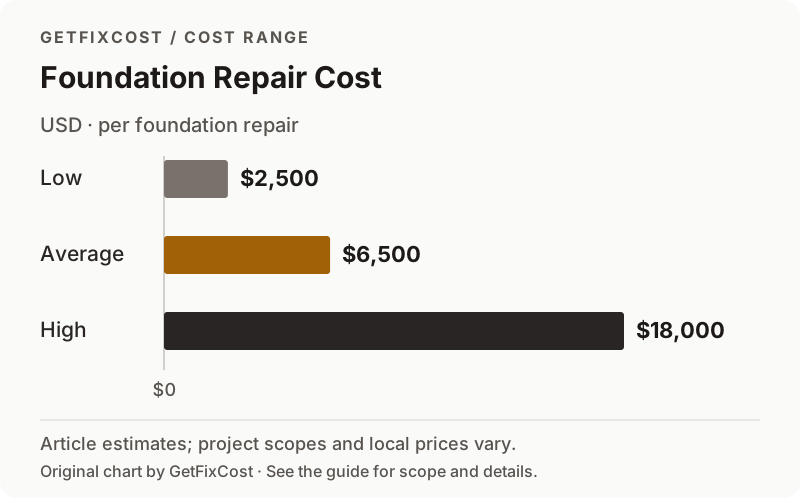
Repairing a residential foundation in the United States typically costs between $2,500 and $18,000, with the national average centering at $6,500 for moderate structural remediation.
Minor non-structural hairline crack repairs sealed with high-pressure epoxy or polyurethane injection cost as little as $450 to $1,200. In contrast, severe structural settlement requiring multiple steel push piers driven to load-bearing bedrock, extensive exterior excavation, and hydraulic house leveling frequently reaches $15,000 to $35,000. Bowing basement walls stabilized with carbon fiber reinforcement straps average $4,000 to $9,000.
Because foundation stabilization directly impacts structural integrity, diagnostic fees are common. Independent structural engineers generally charge $500 to $1,200 for an unbiased stamped engineering evaluation, which provides an objective repair scope before contacting foundation repair contractors.
Quick-Reference Cost Table
| Repair Method | Damage Type / Scope | Average Material & Labor | Typical Project Range | Expected Longevity |
|---|---|---|---|---|
| Epoxy / Polyurethane Injection | Hairline cracks (under 1/8”) | $350 – $600 per crack | $450 – $1,200 | 5 – 10 Years |
| Carbon Fiber Wall Straps | Bowing block walls (inward < 2”) | $700 – $1,100 per strap | $4,200 – $8,800 | Lifetime Warranty |
| Steel I-Beam Wall Bracing | Severe wall bowing (inward > 2”) | $800 – $1,400 per beam | $5,000 – $11,000 | 25+ Years |
| Helical / Push Underpinning | Sinking corners & settlement | $1,400 – $2,400 per pier | $8,500 – $22,000 | Permanent / Bedrock |
| Mudjacking / Polyurethane Foam | Sunken slab foundations / patios | $5 – $15 per square foot | $1,200 – $3,500 | 5 – 10 Years |
Primary Factors Affecting Price
Several geological, structural, and access variables dictate the final cost of foundation stabilization:
- Failure Mechanism (Settling vs. Bowing): Foundation settlement occurs when soil beneath the footing compresses or washes away, causing portions of the house to sink vertically. This requires deep underpinning piers. Inward bowing occurs when expansive clay soils absorb rainwater and exert intense lateral hydrostatic pressure against basement walls, requiring wall anchors, I-beams, or carbon fiber straps.
- Number of Piers Required: For sinking foundations, hydraulic steel push piers or helical screw piers are spaced every 5 to 7 feet along the compromised footing. While a single pier averages $1,400 to $2,400, stabilizing an entire sinking wall corner typically requires six to ten piers, pushing base invoices to $8,500 to $20,000.
- Excavation & Accessibility: Installing piers from the exterior requires heavy machinery or manual trenching down to the footing (often 6 to 9 feet deep). Obstacles such as concrete driveways, air conditioning condensers, gas mains, or prized landscaping increase excavation labor by $1,500 to $4,000.
- Soil Conditions & Depth to Bedrock: Push piers must be hydraulically driven through unstable topsoil until they strike solid bedrock or dense load-bearing strata. In areas with deep alluvial soils, piers may need to penetrate 30 to 60 feet, adding extra modular pipe section expenses.
- Structural Engineering Permits & Inspections: Most municipalities mandate stamped engineering drawings and city building inspections for structural alterations. Permit fees and third-party inspection sign-offs add $400 to $1,000.
Regional Cost Variations Across the US
Regional geology, soil composition, and seasonal weather cycles heavily influence foundation repair frequency and pricing:
- Texas & Southern Plains (Dallas, Houston, Oklahoma City): Infamous for expansive smectite clay soils that swell dramatically when wet and shrink into hard fissures during summer droughts, causing widespread foundation shifting. High contractor density keeps per-pier costs competitive at $1,200 to $1,800 per pier, though projects often require large arrays of 10 to 18 piers.
- Midwest (Kansas City, St. Louis, Chicago): Deep winter freeze-thaw cycles and clay-heavy soils generate extreme lateral hydrostatic pressure against concrete block basements, making carbon fiber straps and steel I-beams the dominant repair, averaging $5,500 to $11,000.
- Northeast (New England, New York, Pennsylvania): Older rubble stone, brick, and unreinforced poured concrete foundations present complex anchoring challenges, pushing average remediation to $8,000 to $16,000.
- West Coast (California, Washington): Strict seismic anchoring codes and geotechnical survey requirements place average foundation stabilization jobs between $9,000 and $22,000.
Repair vs. Replace: Making the Right Call
Complete foundation replacement is an absolute last resort reserved for catastrophic structural failures:
- When to Repair: Over 95% of residential foundation issues can be stabilized permanently using targeted modern technologies (piers, carbon fiber, drainage tiles) without lifting the entire house off its footings. If foundation movement is localized to one side or wall, targeted underpinning costing $6,000 to $15,000 completely restores structural integrity.
- When to Replace: Complete foundation teardown and replacement is only warranted when concrete has severely deteriorated through chemical spalling, alkali-silica reactivity, complete crushing, or massive landslide displacement. Total replacement involves excavating the perimeter, supporting the house on temporary cribbing steel beams, demolishing the old foundation, and pouring a brand-new concrete structure, costing $40,000 to $100,000+.
- The Threshold Rule: If an engineer’s stamped report confirms that inward wall deflection is under 3 inches, non-invasive bracing and water management will save the structure at a fraction of replacement costs.
DIY vs. Hiring a Professional
Structural foundation repair must never be attempted as a DIY project.
While filling hairline shrinkage cracks with surface mortar or installing downspout extensions to divert rainwater is excellent homeowner maintenance, attempting to jack, level, or underpin a sinking home independently is exceptionally dangerous. Improperly positioning hydraulic jacks can crack main plumbing lines, break gas connections, shatter load-bearing framing, and cause catastrophic wall collapse.
Furthermore, foundation repair companies use heavy hydraulic drive heads capable of delivering 10,000 PSI of force to drive galvanized steel tubing to bedrock while monitoring digital pressure gauges. Certified contractors provide transferrable 25-year to lifetime warranties that protect your home’s resale value during municipal home sales disclosures.
Warning Signs You Need Action Now
Early detection prevents minor foundation settling from evolving into five-figure structural overhauls:
- Stair-Step Cracks in Exterior Brickwork: Diagonal cracks following the mortar joints in exterior brick or concrete block walls indicate that one corner of the foundation footing is sinking faster than the rest.
- Doors and Windows That Stick or Jam: When a foundation shifts, door frames and window openings are pulled out of square, causing doors to swing open unprompted, bind at the top latch, or refuse to lock.
- Horizontal Cracks Along Basement Walls: A horizontal crack running mid-height along a basement block wall is a critical warning sign that exterior soil is pressing inward, threatening sudden wall displacement.
- Uneven, Sloping, or Bouncy Interior Floors: Gaps opening between baseboards and the floor or a noticeable slope when walking across a room indicate sinking perimeter footings or sagging center support posts.
Hidden Costs and Common Pitfalls
Review your structural proposals to account for secondary expenses:
- Cosmetic Drywall and Masonry Restoration: Leveling a house with hydraulic piers closes gaps, but it inevitably produces cracks in interior drywall, pop-out screws, and displaced ceramic tile. Post-leveling cosmetic drywall and paint repairs add $1,000 to $3,500.
- Plumbing Under-Slab Leak Testing: Sinking foundations often pull underground sewer and supply pipes. After leveling, an under-slab hydrostatic plumbing test (costing $350 to $600) is critical to verify that lifting didn’t snap brittle cast iron or PVC drain lines.
- Exterior Grading and Landscape Restoration: Repairing torn-up turf, regrading soil slope away from foundation walls, and relocating sprinkler heads adds $800 to $2,500.
How to Save Money and Get Fair Quotes
Follow these disciplined consumer steps to avoid aggressive sales tactics:
- Hire an Independent Structural Engineer First: Before contacting foundation repair sales representatives, pay a licensed Professional Engineer (PE) $500 to $1,000 for an unbiased evaluation. The engineer has no financial stake in selling you piers and will outline the exact minimum repair scope needed.
- Obtain Three Quotes Based on the Engineer’s Report: Hand the engineer’s report to three reputable foundation contractors and ask them to bid strictly on the specified scope. This prevents sales reps from inflating pier counts.
- Verify Warranty Transferability: Ensure the contractor’s warranty is backed by an independent third-party warranty trust or association, and verify that it transfers to future buyers without exorbitant transfer fees.
- Fix Gutters and Downspouts Immediately: More than 70% of foundation settlement is triggered by roof runoff saturating soil right next to the foundation. Installing 10-foot downspout extensions costs less than $50 and stops soil erosion immediately.
Typical Project Timeline
Understanding the phases of structural remediation helps you plan your household routine:
- Phase 1: Engineering Assessment & Permitting (1 to 2 Weeks): The structural engineer inspects elevations with a digital manometer, drafts drawings, and submits permit applications.
- Phase 2: Exterior Excavation (Day 1): Crews manually or mechanically dig access pits (typically 3x3 feet) down to the bottom of the concrete footing at each designated pier location.
- Phase 3: Bracket Attachment & Pier Driving (Days 2 to 3): Heavy-gauge steel brackets are bolted to the footing. Hydraulic drive heads force galvanized steel pier sections deep into the earth until load-bearing resistance is achieved.
- Phase 4: Synchronized Hydraulic Lifting (Day 3 Afternoon): Multiple hydraulic cylinders interconnected to a unified manifold gently lift and stabilize the foundation, monitoring door jambs and laser elevations.
- Phase 5: Backfilling and Site Cleanup (Day 4): Excavation pits are backfilled, soil is tamped, concrete patch work is completed, and city building inspectors conduct the final sign-off. zation.
- How much do steel push piers cost? Underpinning piers cost between $1,400 and $2,400 per pier installed, with most settling sections requiring 6 to 10 piers.
- Can I patch cracks myself? Hairline non-structural cracks under 1/8 inch can be sealed with DIY polyurethane kits, but structural cracks require professional engineering.
- Does insurance cover foundation repair? Standard homeowner policies exclude settling and earth movement unless directly triggered by covered plumbing ruptures.
- How long do foundation repairs last? Steel piers driven to solid bedrock and carbon fiber straps come with transferrable 25-year to lifetime warranties.
Next Steps
If you notice sticking doors, stair-step exterior cracks, or basement wall bowing, hire an independent licensed structural engineer to assess your foundation. Use the engineer’s stamped report to solicit itemized written bids from three verified local foundation contractors.
Frequently Asked Questions
01. How much does the average foundation repair cost ?
02. How much do hydraulic push piers cost per pier?
03. Can foundation cracks simply be patched with hydraulic cement?
04. Does homeowners insurance pay for foundation repairs?
05. How do I know if foundation damage is dangerous?
Related Cost Guides
More in this trade →
Basement Waterproofing Cost
Learn typical basement waterproofing costs by method, including interior drainage, exterior excavation, and sealant options.
Crawl Space Encapsulation Cost
Understand crawl space encapsulation costs for vapor barriers, insulation, dehumidifiers, and full structural upgrades.
Foundation Cracks: Which Are Worth Fixing?
Learn when foundation cracks are worth fixing, including severity assessments and repair cost comparisons.