Project Overview & Direct Cost Answer
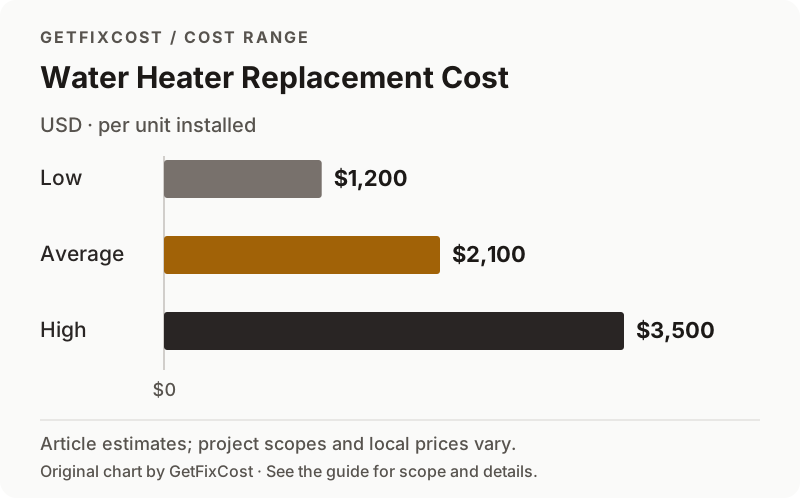
Replacing a residential water heater in the United States typically costs between $1,200 and $3,500, with the national average centering at $2,100 for a standard 40- to 50-gallon tank unit installed by a licensed plumber.
Basic direct-replacement electric tank installations in accessible utility rooms start around $950 to $1,400. Complex power-vented gas systems or conversions requiring new electrical sub-panels frequently reach $2,800 to $4,500. Upgrading to an on-demand tankless water heater generally ranges from $2,500 to $5,500, reflecting additional venting and gas pipe requirements.
Labor typically accounts for 40% to 60% of the total installation invoice. Licensed master plumbers generally charge between $85 and $160 per hour, with most standard tank replacements requiring three to five hours of on-site labor to disconnect, haul away the old unit, make code-compliant copper and gas connections, and test the combustion exhaust.
Quick-Reference Cost Table
| System Type | Tank Capacity | Equipment Only | Average Installed Cost | Expected Lifespan |
|---|---|---|---|---|
| Standard Electric Tank | 40 – 50 Gallons | $450 – $900 | $1,100 – $1,800 | 8 – 12 Years |
| Atmospheric Gas Tank | 40 – 50 Gallons | $600 – $1,100 | $1,300 – $2,300 | 8 – 12 Years |
| Power-Vent Gas Tank | 50 – 75 Gallons | $1,100 – $1,900 | $2,200 – $3,400 | 8 – 12 Years |
| Hybrid Heat Pump Electric | 50 – 80 Gallons | $1,400 – $2,600 | $2,400 – $3,800 | 12 – 15 Years |
| Condensing Tankless Gas | Continuous Flow | $1,100 – $2,200 | $2,600 – $5,200 | 18 – 25 Years |
Primary Factors Affecting Price
Several technical and structural variables dictate where your quote falls within the national cost spectrum:
- Fuel Source (Gas vs. Electric): Electric water heaters are generally simpler and less expensive to install because they require no combustion air or exhaust venting. Gas units require certified gas shut-off valves, sediment traps, flexible connectors, and metal or PVC flue drafting pipes.
- Venting Configuration: Standard atmospheric gas water heaters vent naturally through an existing chimney. If your chimney has deteriorated or your unit is situated far from a chimney, you must install a power-vent model with an electric blower fan that vents exhaust gases horizontally through a side exterior wall, adding $500 to $1,000.
- Tank Capacity and Household Sizing: A two-person household manages well with a 40-gallon tank, whereas a family of four or more requires a 50- to 75-gallon unit to supply simultaneous showers and appliances. Moving up from a 40-gallon to a 75-gallon tank adds $300 to $700 to equipment pricing.
- Physical Accessibility: Replacing a unit located in an open basement or ground-floor garage is straightforward. Installing a replacement in a cramped second-story attic or crawl space requires extra crew members to navigate stairs and narrow doorways, increasing labor costs by roughly 30%.
- Municipal Code Upgrades: If your previous unit was installed 10 to 15 years ago, local plumbing codes have evolved. Installers frequently must add a thermal expansion tank, a dedicated gas sediment trap, brass ball valves, and earthquake strapping (mandatory on the West Coast), adding $200 to $500 in code compliance materials.
Regional Cost Variations Across the US
Labor wages, permit requirements, and regional climate patterns impact total water heater replacement costs:
- Northeast (New York, Boston, Philadelphia): Higher trade wages, older basements with narrow staircases, and historic chimney lining mandates push typical installations to $1,800 to $3,200.
- West Coast (California, Washington, Oregon): Stringent energy efficiency regulations (such as California Title 24 Ultra-Low NOx mandates) and required seismic earthquake restraints position averages between $1,900 to $3,400.
- Midwest (Chicago, Indianapolis, Minneapolis): Hard water conditions accelerate tank corrosion, making replacement common. Readily accessible basements keep average prices between $1,300 and $2,200.
- Southeast & Sunbelt (Florida, Texas, Carolinas): Ground-floor slab foundations and garage placements simplify logistics, keeping average costs between $1,200 and $1,900, though attic-mounted units require specialized drip pans and float switches.
Repair vs. Replace: Making the Right Call
Deciding whether to patch an existing unit or invest in a replacement centers on unit age and failure location:
- When to Repair: If your water heater is under 7 or 8 years old, and the issue involves an external, replaceable component—such as an electric heating element, thermostat, gas thermocouple, or leaking temperature-pressure relief (TPR) valve—a professional repair costing $180 to $450 is financially sensible.
- When to Replace: If water is leaking directly from the bottom or seams of the steel tank, the internal glass lining has fractured, allowing water to corrode the outer steel jacket. Tank corrosion cannot be welded, patched, or repaired; immediate replacement is mandatory.
- The 50% Rule: If the cost of a major repair exceeds 50% of a new system’s installed cost, and the unit is over 8 years old, replacement is the far more prudent decision.
DIY vs. Hiring a Professional
Replacing a residential water heater is rarely a suitable DIY task for homeowners.
While experienced DIYers may feel comfortable draining a tank or replacing an upper heating element, a complete replacement involves high-risk trade overlaps: high-voltage 240V electrical wiring, pressurized explosive natural gas lines, and toxic carbon monoxide exhaust venting. An improperly drafted flue pipe can vent odorless, lethal carbon monoxide back into living spaces. Furthermore, an incorrectly installed temperature-pressure relief valve can transform a pressurized water heater into a severe explosion hazard.
Licensed plumbers carry commercial liability insurance, pull mandatory municipal permits, schedule post-installation safety inspections, and haul away the heavy old tank for eco-friendly recycling.
Warning Signs You Need Action Now
Inspect your water heater periodically for these symptoms of imminent tank failure:
- Rusty or Discolored Hot Water: If rusty water flows exclusively from your hot water faucets while cold water remains clear, the steel tank or internal dip tube is actively deteriorating.
- Popping or Rumbling Noises: Dissolved minerals settle to the bottom of the tank, forming a hardened layer of sediment. As the burner heats trapped water beneath this crust, steam bubbles burst violently, stressing the tank seams.
- Moisture or Pooling Water Around the Base: Even minor weeping around the base indicates that the internal vessel has developed microscopic stress cracks. Complete rupture can occur within days.
- Inconsistent or Dwindling Water Temperature: Failing lower heating elements in electric models or heavy mineral scale accumulation in gas models severely reduces hot water recovery rates.
Hidden Costs and Common Pitfalls
Watch for these non-obvious line items when reviewing written contractor proposals:
- Disposal and Haul-Away Fees: Old water heaters filled with calcified sediment can weigh over 150 pounds. Confirm whether your quote includes the $50 to $120 fee for old equipment removal and scrap metal recycling.
- Thermal Expansion Tank Installation: If your home features a backflow preventer, it is a closed plumbing system. Heating water causes it to expand, creating hydraulic spikes that destroy appliances. Adding an expansion tank typically costs $150 to $300.
- Electrical Circuit Upgrades: Upgrading from gas to a hybrid heat pump water heater often requires running a dedicated 240V, 30-amp electrical circuit from your breaker panel, adding $400 to $900 in electrician fees.
How to Save Money and Get Fair Quotes
Use these practical homeowner guidelines to keep your project on budget:
- Avoid Emergency Weekend Calls: Water heaters frequently fail on weekends. If your tank develops a minor leak that can be contained, or if you can temporarily shut off the water and gas lines, schedule the replacement for standard weekday hours to avoid 50% to 100% overtime labor premiums.
- Verify Utility and Federal Tax Rebates: High-efficiency hybrid heat pump water heaters often qualify for federal Inflation Reduction Act (IRA) energy efficiency tax credits up to $2,000, along with regional electric utility rebates between $300 and $800.
- Compare at Least Three Written Quotes: Request itemized estimates specifying tank brand (such as Bradford White, Rheem, or A.O. Smith), warranty duration (6-year vs. 10-year tanks), expansion tank inclusion, and permit fees.
- Flush the Tank Annually: Once your new water heater is installed, drain and flush three to four gallons of water every 12 months to remove sediment deposits, extending the tank’s operational lifespan by several years.
Typical Project Timeline
Understanding the installation steps helps you prepare for the temporary service outage:
- Step 1: Draining and Shut-Off (30 to 45 Minutes): The plumber shuts off the water supply and electrical breaker or gas valve, connects a hose to the drain valve, and evacuates existing water.
- Step 2: Disconnection and Removal (30 to 45 Minutes): Hot and cold water lines, gas supply piping, and flue vent pipes are disconnected. The old tank is dollied out of the home.
- Step 3: Positioning and Strapping (30 Minutes): The new unit is leveled, set into an emergency drain pan, and strapped to wall framing where required by regional seismic codes.
- Step 4: Hookups and Expansion Tank (1 to 2 Hours): Plumbers sweat copper lines or connect dielectric unions, install the thermal expansion tank, rebuild the gas sediment trap, and hook up the electrical supply.
- Step 5: Testing and Safety Inspection (30 Minutes): The tank is filled completely before firing the heating elements or burner. The technician checks for gas leaks with liquid soap or an electronic sniffer and tests exhaust draft with a smoke pencil.
Next Steps
If your water heater is over 10 years old or shows signs of rust, locate your unit’s data plate to record the model number, fuel type, and gallon capacity. Contact three licensed local plumbing contractors to request itemized proposals covering equipment, labor, expansion tanks, and municipal permits.
Frequently Asked Questions
01. How much does it cost to replace a standard 50-gallon water heater?
02. What is the typical lifespan of a residential tank water heater?
03. Is a tankless water heater worth the extra installation cost?
04. Can I replace a water heater myself to save on labor?
05. Why did my water heater quote include an expansion tank and pressure relief valve?
Related Cost Guides
More in this trade →
Tankless vs Tank Water Heater Cost
Compare tankless versus traditional water heater costs, including installation, operating expenses, and lifespan.
Whole House Repiping Cost
Understand whole-house repiping costs for copper, PEX, and CPVC pipe materials, including labor and wall repairs.
Water Heater Repair or Replace: Decision Guide
Learn when to repair versus replace your water heater, including cost thresholds and age-based decision rules.