Project Overview & Direct Cost Answer
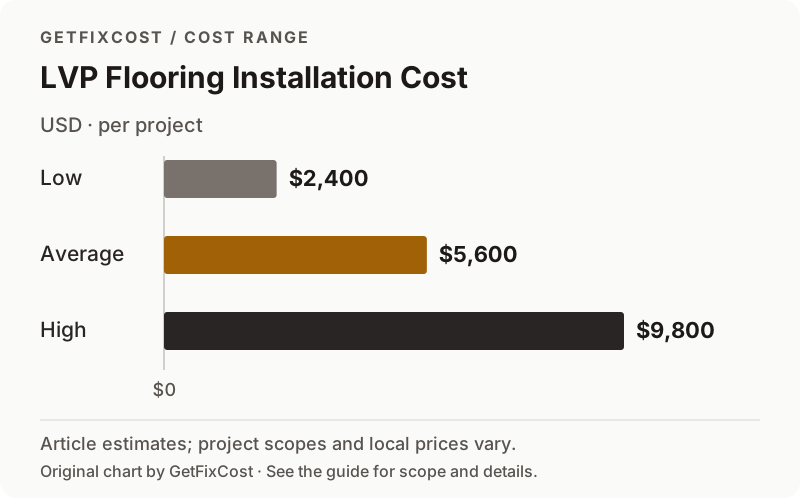
Installing luxury vinyl plank (LVP) flooring in the United States typically costs between $2,400 and $9,800, with the national average centering at $5,600 for a standard 1,000 square foot residential living and dining area.
Overall installed prices range from $4.00 to $10.00 per square foot, combining $1.50 to $5.50 per square foot for plank materials and $2.50 to $4.50 per square foot for professional installation labor. Budget glue-down planks installed in a clean, flat room can cost as little as $3.00 to $4.50 per square foot, while premium rigid-core Stone Plastic Composite (SPC) click-lock planks requiring subfloor grinding, self-leveling underlayment, and extensive baseboard carpentry reach $8.00 to $12.00 per square foot.
LVP has rapidly become the dominant residential flooring material across North America. Combining authentic embossed wood textures with 100% waterproof durability, it delivers the visual warmth of hardwood without the risk of moisture cupping, making it ideal for kitchens, basements, and pet-friendly homes.
Quick-Reference Cost Table
| LVP Quality & Core Tier | Material Price (Sq Ft) | Installed Price (1,000 Sq Ft) | Typical Wear Layer | Best Application |
|---|---|---|---|---|
| Basic Flexible Vinyl Plank | $1.20 – $2.20 | $3,500 – $5,200 | 6 – 8 Mil | Rental turnover, low-traffic guest rooms |
| Standard Click-Lock (WPC/SPC) | $2.50 – $4.00 | $5,000 – $7,500 | 12 – 18 Mil | Main living areas, master bedrooms |
| Premium Rigid Core (SPC) | $4.20 – $6.50 | $7,000 – $10,500 | 20 – 28 Mil | High-traffic hallways, active dogs, kitchens |
| Embossed-in-Register Luxury | $5.50 – $8.50 | $8,500 – $13,000 | 28+ Mil | Custom homes seeking true hardwood realism |
| Glue-Down Commercial Vinyl | $1.80 – $3.50 | $4,800 – $7,200 | 20 Mil | Basements, laundry rooms, high-sun rooms |
Cost Factors That Impact Total Pricing
Several crucial factors dictate the overall cost of an LVP flooring installation:
- Subfloor Preparation: The single biggest pitfall in LVP installation is an uneven subfloor. Modern click-lock joints require subfloors to be flat within 3/16 inch over 10 feet. Grinding high spots in concrete, sistering warped joists, or pouring liquid self-leveling cement adds $1.00 to $2.50 per square foot.
- Old Floor Demolition & Disposal: Ripping out old carpet and padding costs $0.50 to $1.25 per square foot, while chipping out old ceramic tile costs $2.50 to $4.50 per square foot including dust containment and haul-away fees.
- Wear Layer Thickness (Mil Rating): The wear layer is the clear protective polyurethane coating on top of the printed image. Planks with a thin 6-mil to 8-mil wear layer cost under $2/sq ft, whereas commercial-grade 20-mil to 28-mil planks cost $4 to $6/sq ft but resist heavy dog claws and furniture dragging.
- Baseboard & Shoe Molding Trim: Removing existing baseboards, installing new quarter-round shoe molding, or replacing baseboards entirely adds $2.00 to $4.50 per linear foot in carpentry and painting labor.
- Transitions & Stair Treads: Custom flush stair nosings and T-molding transitions between doorways cost $30 to $65 per piece, while finishing an entire staircase in matching LVP costs $75 to $150 per stair tread.
Regional Cost Variations Across the US
Labor rates and local building demand influence flooring installation quotes:
- West Coast (CA, WA, OR): High flooring installer wages ($70–$100/hr) place typical 1,000 sq ft jobs at $6,200 to $10,500.
- Northeast (NY, MA, PA): Older colonial subfloors requiring extensive leveling and leveling compound raise averages to $5,800 to $9,500.
- Midwest (IL, OH, MI): Competitive subcontractor rates keep standard 1,000 sq ft installations around $4,500 to $7,200.
- Southeast & Texas (FL, GA, TX): Abundant single-story slab-on-grade construction keeps labor competitive at $4,200 to $6,800, though concrete moisture barrier prep can add $500 to $1,000.
Repair vs. Replace: How to Decide
Consider whether damaged vinyl flooring should be repaired or completely redone:
- When to Repair: If damage is isolated to a single scratched plank or a few loose transition strips, individual click-lock planks can be unclicked from the wall or cut out and replaced using a specialized plunge-cut repair technique for $150 to $350 using leftover attic stock.
- When to Replace: If your vinyl flooring exhibits widespread telegraphing (subfloor bumps showing through), peeling print layers, hollow clicking sounds underfoot, or separated end-joints across multiple rooms, the entire floor must be removed to correct underlying subfloor levelness.
- The 50% Rule: If repairing widespread joint separation and damaged planks exceeds half the cost of installing a new rigid SPC floor, replace the entire surface to gain modern acoustic and waterproof benefits.
DIY vs. Hiring a Professional & Safety Warnings
Installing floating click-lock LVP in an open, square room is one of the most accessible DIY flooring projects for patient homeowners with basic tools (utility knife, tapping block, pull bar, rubber mallet, and miter saw).
However, subfloor preparation demands serious caution. When tearing out old sheet vinyl or adhesive mastic in pre-1980 homes, materials may contain friable asbestos fibers. Chipping or dry-sanding old adhesive without EPA-certified asbestos testing releases dangerous airborne fibers.
Furthermore, failing to verify subfloor flatness or skipping the 1/4-inch to 3/8-inch perimeter expansion gap will cause the entire floor to peak and tent like a tent pole during seasonal temperature spikes. Hiring professional flooring installers guarantees flat subfloor prep, clean undercut door jambs, and manufacturer-backed warranties.
Warning Signs You Need Action Immediately
Watch for these common issues that indicate floor failure:
- Hollow or Bouncing Planks: A trampoline sensation when walking indicates severe subfloor dips where click-lock joints are flexing and will eventually snap.
- Peaking Joints: If plank edges push up against each other into ridges, the floor was installed without an adequate perimeter expansion gap under the baseboards.
- Plank Separation (Gapping): Noticeable gaps between plank ends occur when room humidity fluctuates drastically or glue-down adhesive loses its bond.
- Telegraphing: Pronounced lines or screw heads visible through the vinyl surface indicate improper subfloor underlayment or lack of skim-coating.
- Musty Odors or White Salt (Efflorescence): In basement installations over concrete, moisture vapor rising from the slab can trap mildew under unvented planks.
Hidden Costs & Contractor Pitfalls
Watch for these common surprise fees on flooring estimates:
- Subfloor Skim-Coating: Leveling uneven plywood seams or filling ceramic tile grout lines adds $0.75 to $1.50 per square foot in quick-setting patch compound.
- Furniture Moving & Appliance Disconnect: Contractors charge $150 to $400 to move heavy furniture, disconnect refrigerators with ice makers, and unhook washing machines.
- Toilet Removal & Wax Ring Reset: Installing flooring in bathrooms requires pulling toilets and resetting them on taller wax rings, costing $100 to $200 per toilet.
- Door Trimming: Thick LVP and underlayment may prevent doors from swinging freely, requiring carpenters to undercut wooden doors for $25 to $50 per door.
How to Save Money and Vet Contractors
Protect your home renovation budget with these practical guidelines:
- Purchase Material Independently with 10% Waste Factor: Homeowners can often save 15% to 25% by buying premium 20-mil LVP directly from wholesale liquidators or home centers, then hiring labor-only flooring subcontractors.
- Handle Tear-Out Yourself: Demolishing old carpet, pulling tack strips, and scraping old glue can save $500 to $1,500 in labor costs before the installation crew arrives.
- Verify Built-in Underlayment: Buy planks with attached IXPE or cork acoustic padding to avoid buying separate rolls of expensive underlayment.
- Require Itemized Quotes: Ensure written contractor bids separate labor rates, subfloor prep allowances, transition molding costs, and dumpster disposal fees.
Typical Project Timeline & Process
A standard 1,000 square foot LVP installation proceeds through these steps:
- Phase 1: Acclimation & Prep (2 to 3 Days): Planks are delivered and allowed to acclimate to indoor room temperature and humidity for 48 hours. Old flooring is removed.
- Phase 2: Subfloor Leveling (Day 1 of Install): High spots are sanded, low spots are leveled with liquid cement, and door jambs are undercut with an oscillating tool.
- Phase 3: Plank Laying (Days 2 to 3): Installers lay the floor row by row, staggering end joints by at least 8 to 12 inches and inserting expansion spacers.
- Phase 4: Trim & Cleanup (Day 4): Spacers are removed, shoe molding or baseboards are installed, transition strips are set, and a final vacuuming is completed.
Next Steps & Estimate Checklist
Before hiring a flooring installer, take these practical preparation steps:
- Measure your rooms (length × width) and add 10% for angled cuts and waste.
- Order physical plank samples to test color against your room’s natural lighting and wall paint.
- Request written, itemized quotes from three local licensed flooring contractors specifying subfloor leveling and trim work.
Frequently Asked Questions
01. How much does LVP flooring cost per square foot installed?
02. What wear layer thickness should I choose for LVP?
03. Is luxury vinyl plank completely 100% waterproof?
04. Can I install LVP over existing tile or sheet vinyl?
05. How long does luxury vinyl plank flooring last?
Related Cost Guides
More in this trade →
Refinish or Replace Hardwood Floors: Decision Guide
Compare refinishing versus replacing hardwood floors, including cost breakdowns and decision factors.