Project Overview & Direct Cost Answer
Deciding whether to refinish or replace hardwood floors comes down to three objective criteria: the remaining thickness of the wood above the tongue-and-groove joint, the severity of water or pet stain damage, and the comparative cost ratio.
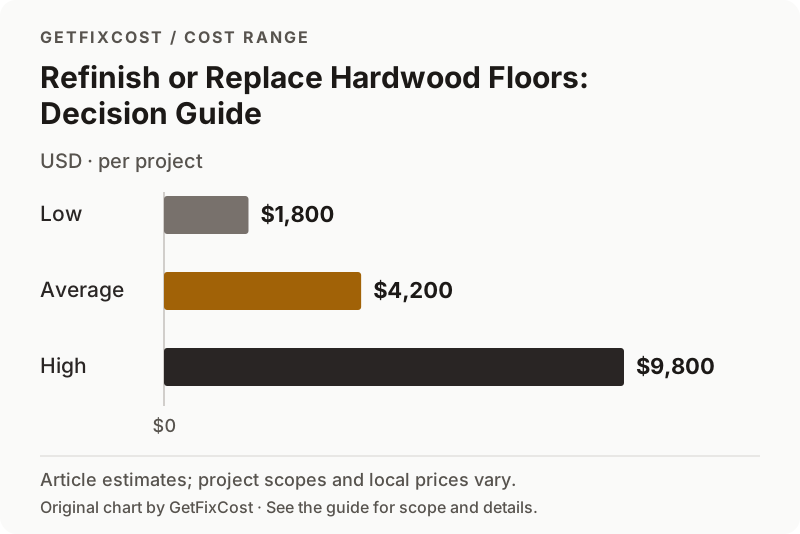
Professionally sanding and refinishing hardwood floors typically costs between $3.00 and $6.00 per square foot, averaging approximately $4,200 for a 1,000 square foot residential living and hallway area. In contrast, tearing out old flooring and installing new solid or engineered hardwood ranges from $8.00 to $16.00 per square foot ($8,000 to $16,000 installed).
If your existing solid hardwood planks are structurally sound, flat, and retain at least 1/8-inch of wood above the tongue-and-groove nails, refinishing is almost always the superior choice. Sanding erases decades of surface scratches, removes worn polyurethane, allows you to customize stain colors, and costs roughly one-third the price of full floor replacement while preserving irreplaceable old-growth timber.
Quick-Reference Cost Table
| Flooring Scope of Work | Cost Per Square Foot | Typical 1,000 Sq Ft Project | Timeline (Including Drying) | Recommended Scenario |
|---|---|---|---|---|
| Screen and Recoat (Buff & Coat) | $1.50 – $2.50 | $1,500 – $2,500 | 1 – 2 Days | Light scuffs, dull finish, zero bare wood |
| Complete Sand, Stain & Refinish | $3.50 – $6.00 | $3,500 – $6,000 | 3 – 5 Days | Surface scratches, color change, worn areas |
| Board Weaving / Spot Wood Patch | $15 – $30 / Sq Ft Patch | $600 – $1,800 (Add-On) | 1 Extra Day | Pet stains, radiator leaks, wall removal |
| New Engineered Hardwood Installed | $8.00 – $14.00 | $8,000 – $14,000 | 2 – 4 Days | Basements, concrete slabs, radiant heat |
| New Solid 3/4” Hardwood Installed | $10.00 – $18.00 | $10,000 – $18,000 | 4 – 7 Days | Severe subfloor rot, beyond sanding life |
Cost Factors That Impact Total Pricing
Several crucial factors determine hardwood refinishing and replacement estimates:
- Total Square Footage & Room Layout: Large open floor plans cost less per square foot ($3.50–$4.50). Narrow hallways, closets, staircases ($40 to $75 per step), and rooms with multiple radiators require extensive hand-edging labor.
- Dustless Sanding Containment: Professional crews use specialized trailer-mounted HEPA vacuum systems that evacuate 98% of airborne wood dust through outdoor hoses, adding $0.50 to $1.00 per square foot over traditional bag sanders.
- Stain Color & Bleaching: Applying natural clear polyurethane is standard. Custom dark stains, gray tones, or reactive wood bleaching require water-popping the grain and an extra dye application, adding $0.75 to $1.50 per square foot.
- Polyurethane Type (Water-Based vs. Oil-Based): Traditional oil-based polyurethane is durable and amber-tones wood, but takes 24 hours per coat to dry and emits strong VOC fumes. Commercial water-based polyurethane (like Bona Traffic HD) dries in 3 hours, emits minimal odor, and cures harder, but adds $0.75 to $1.25 per square foot.
- Old Carpet & Tack Strip Removal: Ripping up old carpet, pulling thousands of metal staples, and disposing of carpet padding adds $0.50 to $1.25 per square foot.
Regional Cost Variations Across the US
Labor wages and regional housing styles dictate hardwood pricing:
- Northeast (NY, MA, PA, CT): Historic colonial housing stock with wide-plank oak and pine makes refinishing dominant, averaging $4.00 to $6.50 per sq ft ($4,000 to $6,500 per 1,000 sq ft).
- West Coast (CA, WA, OR): High flooring craftsman wages ($80–$120/hr) and strict environmental zero-VOC finish regulations place refinishing at $4.50 to $7.00 per sq ft.
- Midwest (IL, OH, MI, WI): Competitive flooring markets and abundant hardwood mills keep refinishing around $3.00 to $5.00 per sq ft.
- South & Texas (TX, FL, GA): Slab-on-grade foundations favor engineered wood replacement over solid, with refinishing averaging $3.20 to $5.20 per sq ft.
Repair vs. Replace: How to Decide
Use these practical technical tests to determine whether to refinish or replace:
- The Dime Test for Remaining Wood Thickness: Inspect a floor vent opening or doorway transition where the wood edge is visible. Measure the thickness of the wood above the tongue groove. If the wood layer is thinner than a standard US dime (roughly 1/16-inch), the floor cannot be sanded again without exposing nail heads and breaking grooves. Replacement is required.
- Deep Pet Urine & Chemical Stains: Pet urine contains ammonia that chemically burns and blackens oak tannins deep into the core. Surface sanding will not remove deep black stains. However, you do not need to replace the entire floor: a flooring craftsman can weave in a dozen matching new oak boards and sand everything to a uniform match.
- Severe Cupping or Buckling from Floods: If a major pipe break warped boards and the wood cannot dry flat within 3 to 4 weeks of dehumidification, replacement is necessary.
- The 50% Rule: If board replacement, subfloor leveling, and refinishing costs exceed half the cost of new pre-finished hardwood, replace the floor.
DIY vs. Hiring a Professional & Safety Warnings
While homeowners can rent drum sanders from home improvement centers, DIY hardwood refinishing carries immense risks of permanent floor destruction.
Operating a 220-volt heavy drum sander requires refined muscle memory; pausing the machine for even one second while the drum is engaged cuts deep, permanent divots (drum marks) across wood planks that cannot be erased without losing substantial floor lifespan. Furthermore, cross-grain sanding with orbital edge sanders leaves visible swirl marks that show conspicuously under dark stains.
Professional hardwood refinishers carry multi-disc planetary sanders, commercial edge trimmers, moisture meters, and HEPA dust containment systems. They understand how different wood species (red oak vs white oak vs maple) absorb stain pigments, ensuring smooth, furniture-grade results.
Warning Signs You Need Action Immediately
Inspect your hardwood floors for these symptoms of distress:
- Gray or Black Bare Wood Patches: Gray patches in high-traffic hallways indicate the polyurethane finish has worn off completely and bare wood is absorbing dirt and water.
- Deep Scratches Exposing Raw Lumber: Scratches from dog claws or furniture dragging through the clear coat allow mopping water to penetrate and stain grain.
- Squeaking or Spongy Floor Boards: Extensive squeaking across multiple joist bays indicates loose subfloor nailing or broken tongue-and-groove joints.
- Excessive Gapping in Winter: Gaps wider than a nickel (over 1/8-inch) between boards indicate extreme indoor humidity fluctuations that may require humidifier installation.
- Splintering Board Edges: Splintered plank edges indicate the wood has been sanded too thin near the tongue line.
Hidden Costs & Contractor Pitfalls
Scrutinize hardwood flooring proposals for these commonly excluded items:
- Furniture Moving & Appliance Handling: Emptying rooms completely is mandatory. Contractors charge $200 to $600 to move heavy furniture, disconnect refrigerators, and pull toilets.
- Baseboard & Shoe Molding Replacement: Removing shoe molding prevents sander edging gouges on baseboards; replacing shoe molding costs $2.00 to $4.50 per linear foot.
- Subfloor Fastening & Screw-Down: Driving screws through subfloors into joists to silence squeaks before sanding costs $150 to $350.
- Hotel or Boarding Accommodation: Oil-based finishes require 3 to 4 days of vacating the home due to toxic fumes; factor in lodging expenses.
How to Save Money and Vet Contractors
Protect your home renovation budget with these practical guidelines:
- Screen and Recoat Early: If your floors have light surface scuffs but no bare wood, a “buff and coat” ($1.50 to $2.50/sq ft) applies a fresh layer of polyurethane without sanding down raw wood, saving 50% and doubling finish life.
- Handle Carpet & Furniture Removal Yourself: Demolishing old carpet, pulling tack strips, and clearing rooms before the crew arrives saves $500 to $1,200.
- Opt for High-Traffic Water-Based Polyurethane: While water-based finishes cost slightly more per gallon, their fast 3-hour dry time lets crews finish the job in 2 days instead of 4, saving on labor and hotel stays.
- Obtain Three Itemized Quotes: Require bids to specify dustless vacuum systems, number of polyurethane coats (insist on minimum 3 coats), and board repair rates.
Typical Project Timeline & Process
A standard 1,000 square foot hardwood refinishing project proceeds as follows:
- Phase 1: Room Prep & Carpet Tear-Out (Day 1): Rooms are cleared, tack strips removed, protruding nails set below surface, and doorways sealed with plastic.
- Phase 2: Progressive Sanding (Days 1 to 2): Floors are sanded in three passes with coarse (36-grit), medium (60-grit), and fine (100-grit) sandpaper, followed by orbital edge sanding.
- Phase 3: Staining & First Coat (Day 3): Wood stain is wiped and buffed into the grain, followed by the first sealer coat.
- Phase 4: Finish Coats & Curing (Days 4 to 5): Floors are lightly buffed between coats, and two heavy topcoats of commercial polyurethane are applied. Floors cure for 48 hours before sock traffic.
Next Steps & Estimate Checklist
Before scheduling hardwood flooring contractor walkthroughs:
- Inspect floor vent openings to verify wood thickness above the tongue-and-groove joint.
- Measure your room dimensions (length × width) to calculate approximate square footage.
- Request written itemized quotes from three licensed local hardwood flooring contractors specifying dustless sanding and three finish coats.
Frequently Asked Questions
01. How much does it cost to refinish hardwood floors vs replace them?
02. How many times can a solid hardwood floor be refinished?
03. Can engineered hardwood floors be refinished?
04. Can deep pet urine stains be sanded out of hardwood?
05. How long does hardwood floor refinishing take?
Related Cost Guides
More in this trade →
LVP Flooring Installation Cost
Understand LVP flooring installation costs per square foot, including underlayment, labor, and subfloor preparation.