Project Overview & Direct Cost Answer
Deciding whether to repair or replace your residential roof comes down to three objective criteria: the age of the roofing system, the square footage and cause of the damage, and the comparative cost ratio.
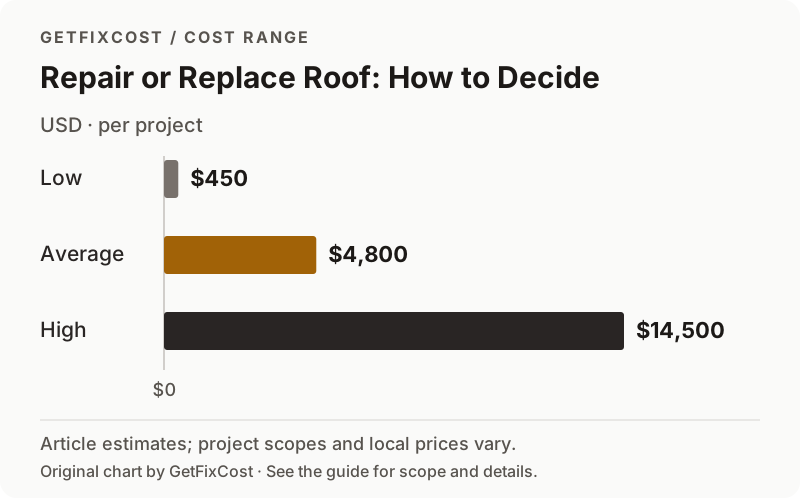
A professional spot repair typically costs between $450 and $1,250, addressing localized issues such as blown-off shingles, rusted step flashing, or deteriorated rubber pipe boots. In contrast, a complete roof replacement averages $9,400 to $16,500 for a standard 2,000 square foot home. If your roof is less than 15 years old and the affected area represents less than 15% to 20% of the total surface, repairing is almost always the smarter, more economical decision.
However, if your shingles are nearing 20 years of service, have shed their protective mineral granules, or have suffered widespread storm and deck rot damage, pouring thousands of dollars into spot patches is a losing financial proposition. A new roof immediately restores building envelope integrity, prevents structural ceiling rot, and delivers an average 60% to 68% return on investment (ROI) in property resale value.
Quick-Reference Cost Table
| Scenario | Average Cost | Typical Scope of Work | Expected Lifespan Added | Strategic Verdict |
|---|---|---|---|---|
| Minor Spot Repair | $350 – $750 | Replace 5–15 shingles, reseal flashing, patch ridge cap | 1 – 3 Years | Best for roofs under 12 years old with isolated leaks |
| Major Flashing & Valley Repair | $850 – $2,200 | Re-flash chimney, replace valley metal, strip 1 square | 3 – 5 Years | Best for older roofs where leaks are isolated to transitions |
| Partial Roof Slope Replacement | $2,500 – $5,500 | Tear off and reshingle one entire windward roof plane | 15 – 25 Years | Good for storm damage confined to a single roof face |
| Complete Architectural Shingle Reroof | $7,800 – $14,500 | Full tear-off, new synthetic underlayment, ice shield | 25 – 30 Years | Best for roofs over 18 years old or widespread granule loss |
| Complete Standing-Seam Metal Reroof | $16,000 – $32,000 | Tear-off, heavy underlayment, custom fabricated panels | 40 – 70 Years | Permanent upgrade for long-term homeowners in severe climates |
Cost Factors That Impact Total Pricing
Whether you decide to patch or replace, several structural and logistical variables dictate the final estimate:
- Roof Pitch & Accessibility: Roofs with steep slopes over 6/12 require specialized safety harnesses and roof jacks, increasing both repair and replacement labor rates by 20% to 35%.
- Existing Shingle Layers: If your roof already has two layers installed, building codes prohibit adding a third. A complete double-layer tear-off increases disposal and labor fees to roughly $2.00 to $2.75 per square foot.
- Plywood Decking Condition: Water that bypasses shingles rots the underlying OSB or CDX plywood sheathing. Replacing rotted decking costs $75 to $125 per sheet installed.
- Architectural Complexity: Dormers, intersecting gables, turrets, and skylights require custom metal flashing and water membranes, increasing labor hours significantly.
- Material Matching: Asphalt shingles fade under sunlight over time. A spot patch on a 10-year-old roof will often stand out as a conspicuous dark rectangle.
Regional Cost Variations Across the US
Regional weather patterns and local labor markets create noticeable differences in contractor estimates:
- West Coast & Pacific Northwest: High prevailing wages and cool-roof environmental mandates make spot repairs average $600 to $1,500, while complete replacements range between $11,000 and $19,000.
- Northeast: Severe winter ice damming, heavy snow loads, and older multi-story homes raise repair costs to $550 to $1,350 and replacements to $9,500 to $16,500.
- Midwest: Straightforward ranch and colonial architecture keep repair averages between $400 and $900, with full replacements averaging $7,500 to $12,000.
- Southeast & Gulf Coast: Stringent coastal wind-borne debris codes (such as Florida Building Code TAS 100) require hurricane-rated shingles, driving complete replacements to $8,800 to $15,000.
Repair vs. Replace: How to Decide
Evaluate your roofing situation using this structured four-step decision framework:
- The Age Threshold: Asphalt shingles carry design lifespans of 20 to 30 years. If your roof is under 10 years old, default to a repair unless structural trauma has occurred. If your roof is 18 to 25 years old, shingles are brittle, and nailing in new shingles will crack adjacent tabs.
- The 50% Financial Rule: If a contractor repair estimate exceeds 50% of the replacement price, replacement is the mathematically sound choice, resetting the warranty clock.
- The 25% Building Code Rule: In many jurisdictions adhering to the International Existing Building Code (IEBC), if more than 25% of a roof section is damaged within a 12-month period, the entire roof must be brought up to current code, triggering full replacement.
- Avoid Roof Overlays: While installing a second layer of shingles over an existing roof saves immediate tear-off costs, roofers discourage it. Overlays trap excess attic heat, prevent inspecting wood decking for hidden rot, and void shingle manufacturer wind warranties.
DIY vs. Hiring a Professional & Safety Warnings
Minor maintenance like clearing pine needles from roof valleys can be tackled by experienced homeowners, but repairing leaks and replacing shingles involves serious safety hazards.
Falls from roofs represent one of the leading causes of fatal injuries in residential construction. Stepping on brittle, wet, or moss-covered shingles can cause instant loss of footing. Furthermore, tracking down the exact origin of a ceiling leak is deceptive: water frequently penetrates a cracked flashing piece, travels 15 feet down a rafter, and drips onto drywall far from the original opening.
Licensed roofing contractors carry professional fall-arrest harnesses, calibrated pneumatic nailers, and specialized flashing tools. They also carry $1,000,000+ in general liability and workers’ compensation coverage, protecting you from on-site personal injury liability.
Warning Signs You Need Action Immediately
Inspect your roof from the yard using binoculars twice a year, especially after major storms:
- Excessive Granule Loss: Black sand-like granules piling up at the base of your downspouts indicate the protective asphalt binder is breaking down from UV radiation.
- Cupping or Curling Shingles: Shingles whose edges curl upward or downward have lost their adhesive seal and are vulnerable to blow-offs.
- Missing Shingles Exposing Felt: If wind storms blow off shingles and leave dark black underlayment exposed, water will enter the house within the next heavy rain.
- Attic Rafter Stains & Mold Growth: In your attic, dark water stains on plywood decking or fuzzy mold along rafters indicate long-term moisture intrusion that demands remediation.
- Sagging Roofline: A visible dip along the roof ridge or between rafters signals structural decking or truss failure requiring immediate professional evaluation.
Hidden Costs & Contractor Pitfalls
Beware of these common unexpected expenses when navigating roof bids:
- Decking Rot Uncovered Post-Tear-Off: Until old shingles are stripped away, the condition of the plywood decking cannot be verified. Reputable contractors include an explicit per-sheet replacement rate in the contract.
- Chimney Cricket & Flashing Rebuilding: If your chimney is wider than 30 inches, building codes require a peaked cricket structure behind it to divert water, costing $500 to $1,200.
- Attic Ventilation Upgrades: To validate modern shingle manufacturer warranties, your attic must feature balanced intake and exhaust ventilation. Adding ridge vents costs $450 to $900.
How to Save Money and Vet Contractors
Maximize your roofing investment with these proven homeowner strategies:
- Request Three Independent Written Quotes: Solicit bids from well-reviewed local roofing contractors with established physical business addresses in your county. Avoid storm-chasing contractors knocking on doors after hailstorms.
- Review Insurance Matching Requirements: If filing an insurance claim for wind or hail damage, research your state’s matching laws. If contractors cannot match existing shingle colors, insurers may be required to pay for full replacement.
- Inquire About Off-Peak Scheduling: Late winter and early spring represent slower seasons for roofing crews, often yielding a 5% to 10% discount on labor.
- Demand Complete Material Specifications: Ensure written bids specify the exact underlayment brand (synthetic underlayment over cheap organic felt), drip edge gauge, starter strips, and ice and water barrier coverage.
Typical Project Timeline & Process
A standard residential roof repair or replacement proceeds through predictable phases:
- Step 1: Inspection & Proposal (2 to 5 Days): The roofer conducts a ground and roof-level inspection, measures square footage, checks attic ventilation, and presents an itemized written estimate.
- Step 2: Material Delivery & Permitting (1 to 2 Weeks): Municipal permits are pulled, and bundles of shingles and underlayment are delivered by boom truck directly onto the roof or driveway.
- Step 3: Execution (1 to 2 Days for Replacement; 2 to 4 Hours for Repair): For a replacement, the crew protects landscaping with tarps, strips existing materials down to bare wood, replaces damaged plywood, installs underlayment and flashing, and nails down new shingles.
- Step 4: Cleanup & Magnetic Sweep (2 Hours): The crew runs powerful rolling magnets across your lawn, driveway, and flowerbeds to collect thousands of discarded roofing nails, leaving the property clean and safe.
Next Steps & Estimate Checklist
Before committing to a contractor proposal, complete this due-diligence checklist:
- Document the age of your roof through past home permits or closing disclosures.
- Take clear ground-level photos of missing shingles, curling tabs, or interior ceiling stains.
- Request three written proposals from licensed local contractors that itemize both repair and full replacement options.
- Check contractor credentials with the Better Business Bureau and state licensing boards.
Frequently Asked Questions
01. What is the 50 percent rule for roof repair or replacement?
02. How much does a typical roof spot repair cost?
03. Can a roof with two layers of shingles be repaired?
04. Will homeowners insurance cover a partial roof repair or require a full replacement?
05. How can I tell if my asphalt shingles are at the end of their life?
Related Cost Guides
More in this trade →
Roof Repair Cost
Get realistic roof repair costs for shingle replacement, flashing repairs, leak fixes, and storm damage restoration.
Roof Replacement Cost
Learn roof replacement costs by material: asphalt shingles, metal, tile, and slate, including labor and tearoff fees.