Project Overview & Direct Cost Answer
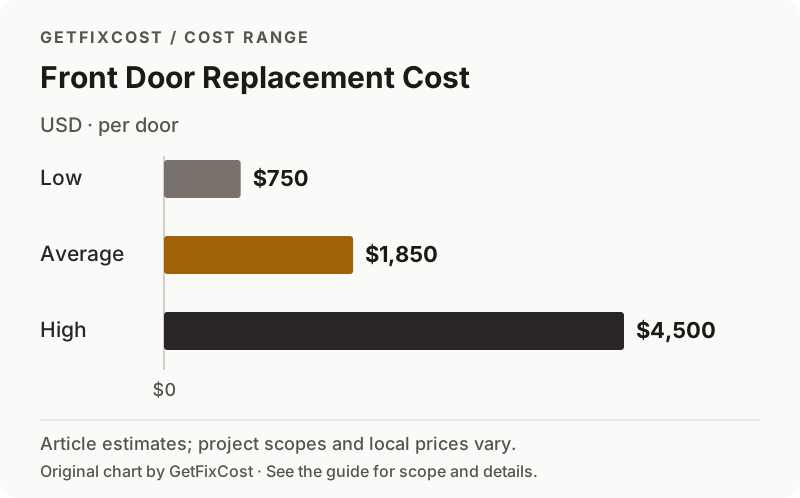
Replacing a front entry door in the United States typically costs between $750 and $4,500, with the national average centering at $1,850 for a standard pre-hung fiberglass or insulated steel entry door with professional carpentry labor and trim.
A basic replacement using an energy-efficient steel slab door in an existing square frame starts around $750 to $1,200. In contrast, premium installations featuring textured woodgrain fiberglass doors with decorative glass inserts, matching sidelights, arched transoms, and smart multi-point security hardware range from $3,200 to $6,500+. Custom solid hardwoods like mahogany or oak reach $5,000 to $10,000+.
Your front door serves as the architectural focal point of your home’s exterior facade and the primary barrier against cold drafts and forced entry. Upgrading an aging, drafty entry door immediately improves home security, lowers winter heating bills, and delivers an average 65% to 75% return on investment in property resale value.
Quick-Reference Cost Table
| Door Material & Configuration | Average Installed Cost | Energy Efficiency (R-Value) | Maintenance Needs | Primary Homeowner Advantage |
|---|---|---|---|---|
| Basic Insulated Steel (No Glass) | $750 – $1,400 | R-5 to R-6 | Low (paint touchup) | Maximum security, lowest purchase cost |
| Smooth Paintable Fiberglass | $1,200 – $2,200 | R-6 to R-7 | Very Low (zero rot) | Will not dent, rust, or warp |
| Woodgrain Textured Fiberglass | $1,800 – $3,400 | R-6 to R-7 | Low (stain every 5 yrs) | Authentic rich wood look without wood rot |
| Door with Single Sidelight | $2,200 – $4,200 | R-5 to R-7 | Low to Moderate | Adds natural light into dark entryways |
| Double Entry Doors (6-Ft Width) | $3,200 – $6,500 | R-5 to R-7 | Low to Moderate | Grand entrance opening for furniture moving |
| Custom Solid Wood (Mahogany/Oak) | $4,000 – $9,500 | R-2 to R-3 | High (seal/varnish) | Unmatched luxury, historic architectural fidelity |
Cost Factors That Impact Total Pricing
Several crucial factors determine your total front door replacement estimate:
- Pre-Hung vs. Slab Door: Installing a slab door requires mortising hinge recesses and drilling locksets into raw wood ($400–$800). Pre-hung door systems include weatherstripped jambs, hinges, and an adjustable threshold ($1,200–$2,800), ensuring airtight performance.
- Glass Inserts & Sidelights: Solid doors cost the least. Adding decorative caming, frosted privacy glass, Low-E tempered glass inserts, or flanking sidelights adds $400 to $1,500 to the door unit.
- Sub-Sill Framing & Rot Repair: Water seeping under old thresholds frequently rots the subfloor and rim joist. Replacing rotten sub-framing and installing a waterproof composite sill pan adds $150 to $450.
- Hardware & Smart Locksets: Standard keyed entry locksets with deadbolts cost $50 to $150. Heavy-duty multi-point locking systems, biometric smart locks, or forged brass handlesets add $200 to $600.
- Trim & Paint Finishing: Pre-finished or factory-stained doors cost $300 to $600 more than unfinished doors, but save the time and expense of hiring a painter to brush coats on bare doors.
Regional Cost Variations Across the US
Labor wages and climate codes influence entry door replacement bids:
- West Coast (CA, WA, OR): High finish-carpenter wages ($85–$135/hr) and strict Title 24 energy standards place typical pre-hung replacements at $2,100 to $3,800.
- Florida & Coastal Hurricane Zones: Building codes mandate impact-rated fiberglass or heavy-gauge steel doors tested to resist missile impacts and positive/negative hurricane pressures, averaging $2,500 to $4,500.
- Northeast (MA, NY, PA): Older historic homes requiring custom-sized jambs to fit settling openings average $1,800 to $3,200.
- Midwest & South (IL, OH, TX, GA): Standard suburban rough openings and competitive contractor markets keep installations around $1,200 to $2,400.
Repair vs. Replace: How to Decide
Determine whether your front door can be restored or requires replacement:
- When to Repair: If the door slab is straight, structurally sound, and free of rot, but suffers from worn-out weatherstripping, a loose brass hinge, or a drafty sweep, professional weatherization costing $100 to $250 will eliminate drafts. Repainting a faded door costs $150 to $300.
- When to Replace: If the door is warped, the bottom edge drags across the floor, daylight is visible around perimeter jambs when latched, wood sills are crumbling with dry rot, or steel skins are rusted through, complete pre-hung replacement is necessary.
- The 50% Rule: If restoring an old door (stripping paint, rebuilding wood sills, mortising new hinges, and reglazing glass) exceeds half the cost of a modern fiberglass pre-hung unit, replacement is the smarter investment.
DIY vs. Hiring a Professional & Safety Warnings
Installing a slab door or applying self-adhesive foam weatherstripping is a manageable weekend DIY task for homeowners with carpentry experience.
However, installing a heavy pre-hung exterior entry door requires professional carpentry skills.
Exterior doors must be shimmed precisely plumb, level, and square within 1/16 of an inch; any minor twist in the jamb will prevent latches from engaging and create continuous air drafts. Furthermore, proper sill pan flashing is essential; improper flashing allows driven rain to seep under the threshold, rotting the floor joists and subfloors below. Professional door installers ensure weather-tight flashing, fire-rated security, and effortless deadbolt engagement.
Warning Signs You Need Action Immediately
Inspect your entry door for these telltale signs of failure:
- Visible Daylight Around Door Perimeter: Daylight shining between the door slab and weatherstripped jamb indicates warped framing or worn seals.
- Drafts and Cold Floors in Foyer: Feeling cold air breezes near your entryway floor during winter indicates failed bottom door sweep seals.
- Difficulty Latching or Locking Deadbolt: Needing to pull or push the door with heavy body weight to turn the key indicates frame settling or door sag.
- Soft Wood on Sills and Brickmould: Screwdrivers sinking easily into the bottom exterior jamb wood indicates moisture rot.
- Moisture or Rust Between Glass Panes: Foggy condensation inside decorative door glass indicates failed thermal seals.
Hidden Costs & Contractor Pitfalls
Watch for these common extra fees on entry door contractor bids:
- Non-Standard Opening Sizes: Older homes often feature 32x82 or 34x80-inch openings. Ordering a custom-sized door adds $200 to $600 compared to standard 36x80-inch stock units.
- Sill Pan Flashing Installation: A durable PVC or aluminum sill pan protects subflooring from moisture leaks, adding $75 to $150.
- Storm Door Reinstallation: Removing and re-hanging an existing storm door on the new brickmould casing adds $100 to $200.
- Interior Casing & Painting: Painting new interior wood trim and door jambs adds $150 to $350 if not included in the carpentry quote.
How to Save Money and Vet Contractors
Maximize your front door investment with these proven homeowner tips:
- Choose Smooth Fiberglass Over Wood: Smooth fiberglass provides double the thermal insulation of wood, zero rot risk, and costs 40% to 60% less than authentic solid hardwood.
- Claim Federal 25C Energy Tax Credits: Installing an ENERGY STAR certified exterior door qualifies for a 30% federal tax credit up to $250 per door (up to $500 total per year for two doors).
- Purchase Pre-Finished Doors: Factory-applied paint or stain finishes carry 5 to 10-year warranties and eliminate the labor expense of hiring an on-site painter.
- Obtain Three Itemized Written Bids: Require bids to specify door brand (Therma-Tru, Masonite, ProVia), jamb material (composite vs wood), hardware brand, and permit inclusion.
Typical Project Timeline & Process
A professional pre-hung front door installation takes just 4 to 8 hours:
- Phase 1: Measurement & Ordering (2 to 4 Weeks): Opening dimensions, jamb depth (4-9/16” vs 6-9/16”), and door swing (inswing left or right) are verified, and the door unit is delivered.
- Phase 2: Removal & Framing Inspection (1 to 2 Hours): The old door, jamb, and threshold are removed. Rough framing is inspected for rot, leveled, and waterproof pan flashing is set.
- Phase 3: Setting & Shimming (2 Hours): The pre-hung unit is placed, leveled with composite shims, fastened with 3-inch security screws through the hinges into wall studs, and tested for squareness.
- Phase 4: Insulation & Trim-Out (1 to 2 Hours): Low-expansion foam insulation is injected, interior trim is nailed, exterior brickmould is caulked, and locksets are calibrated.
Next Steps & Estimate Checklist
Before scheduling front door installer walkthroughs:
- Measure your door slab width, height, and wall jamb thickness (4-9/16” for 2x4 walls or 6-9/16” for 2x6 walls).
- Note door swing direction (standing outside, do hinges sit on the left or right, and does the door swing inward?).
- Request itemized written proposals from three licensed door installation contractors.
Frequently Asked Questions
01. How much does it cost to replace a front entry door on average?
02. Which is better: fiberglass or steel front doors?
03. What is the difference between a pre-hung door and a slab door?
04. How long does a front door replacement take?
05. Does replacing a front door improve home value?
Related Cost Guides
More in this trade →
Garage Door Replacement Cost
Understand garage door replacement costs for single and double doors, including opener installation and labor.
Sliding Glass Door Replacement Cost
Get realistic sliding glass door replacement costs, including frame materials, glass options, and installation labor.
Window Replacement Cost
Get realistic window replacement costs per window, including double-hung, casement, and bay window options.