Project Overview & Direct Cost Answer
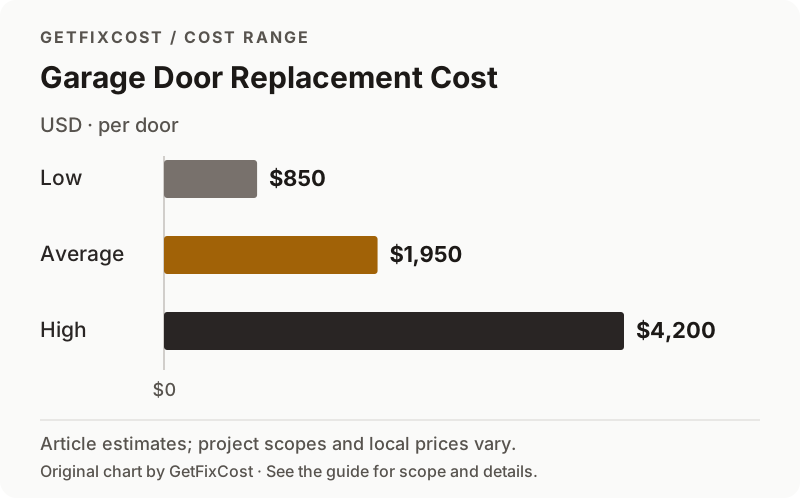
Replacing a residential garage door in the United States typically costs between $850 and $4,200, with the national average centering at $1,950 for a standard 16x7-foot double door using insulated steel with professional installation, new tracks, and high-cycle torsion springs.
A basic, uninsulated single-car 8x7-foot steel door can cost as little as $750 to $1,200 installed. In contrast, premium carriage-house style doors, architectural full-view aluminum and glass doors, or custom clear-cedar wood doors range from $3,500 to $8,000+. Adding a modern belt-drive smart garage door opener adds $350 to $650.
Because garage doors often cover 30% or more of a home’s front facade, replacing an old, dented door delivers immediate curb appeal. Furthermore, Remodeling Magazine’s Cost vs. Value Report consistently rates garage door replacement as the #1 return on investment (ROI) project, returning an average 95% to 102% of its cost at resale.
Quick-Reference Cost Table
| Door Style & Material | Door Size | Installed Cost Range | Typical Insulation (R-Value) | Ideal Household Application |
|---|---|---|---|---|
| Basic Single-Layer Steel | 8x7 Ft (Single Car) | $750 – $1,200 | Non-Insulated (R-0) | Detached garages, mild climates |
| Standard Insulated Steel (Polystyrene) | 16x7 Ft (Double Car) | $1,400 – $2,400 | R-6 to R-9 | Most attached suburban garages |
| Premium Triple-Layer Steel (Polyurethane) | 16x7 Ft (Double Car) | $2,200 – $3,600 | R-14 to R-18 | Heated garages, workshops, bedrooms above |
| Carriage House Overlay / Faux Wood | 16x7 Ft (Double Car) | $2,800 – $4,800 | R-12 to R-16 | Maximum architectural curb appeal |
| Full-View Glass & Black Aluminum | 16x7 Ft (Double Car) | $3,500 – $7,500 | R-0 to R-4 | Modern contemporary luxury residences |
| Solid Natural Wood (Cedar / Mahogany) | 16x7 Ft (Double Car) | $4,000 – $9,500 | R-5 to R-8 | Historic or custom craftsman estates |
Cost Factors That Impact Total Pricing
Several crucial hardware and design variables determine your garage door estimate:
- Door Size (Single vs. Double): A standard single 8x7 or 9x7 door costs roughly 40% less than a 16x7 or 18x7 double-car door in materials and labor.
- Door Construction Layers (1-Layer vs 2-Layer vs 3-Layer): Single-layer doors feature a single sheet of stamped steel ($800–$1,200). Triple-layer “sandwich” doors feature heavy exterior steel, foamed-in-place polyurethane insulation, and an interior steel backing sheet ($1,800–$3,200), providing exceptional durability and quiet operation.
- Torsion Springs vs. Extension Springs: High-tension torsion springs mounted on a center shaft above the door cost $100 to $200 more than side-mounted extension springs, but operate much smoother and last 15,000 to 20,000 cycles compared to 10,000 cycles for extension springs.
- Decorative Windows and Hardware: Adding top-panel decorative windows with obscure or tempered glass adds $200 to $600, while magnetic or bolted stamped steel handles and strap hinges add $50 to $150.
- Opener Replacement: Upgrading to a whisper-quiet DC motor belt-drive opener with integrated battery backup, Wi-Fi connectivity, and camera monitoring adds $350 to $650.
Regional Cost Variations Across the US
Regional climate requirements and local labor rates dictate garage door pricing:
- Florida & Coastal Hurricane Zones: Building codes mandate high-wind impact-resistant garage doors reinforced with heavy steel U-bars to withstand 130–150 mph winds, adding $500 to $1,200 over standard doors ($2,400 to $4,500 average).
- Northern Midwest & Northeast: Freezing winters make R-14 to R-18 polyurethane insulated doors standard, averaging $1,800 to $3,200.
- West Coast (CA, WA, OR): California SB 969 mandates that all newly installed garage door openers include a working battery backup, raising average opener packages to $450 to $700.
- South & Texas: Mild winter climates keep baseline single-layer and two-layer door replacements competitive at $1,200 to $2,200.
Repair vs. Replace: How to Decide
Determine whether a minor garage door repair or complete replacement is appropriate:
- When to Repair: If the door is mechanically sound but has a broken spring, frayed lift cables, worn-out rollers, or a failed opener photo-eye, professional repair costing $150 to $350 will quickly restore operation.
- When to Replace: If multiple horizontal door panels are dented or cracked (from vehicle impact), bottom panels are severely rusted from road salt, or the door is an obsolete uninsulated model, full replacement is the smartest investment.
- The 50% Rule: Replacing individual stamped steel door panels costs $400 to $800 each. If replacing two damaged panels approaches half the cost of a brand-new complete door system, replace the entire assembly.
DIY vs. Hiring a Professional & Safety Warnings
Homeowners can safely handle simple maintenance like lubricating steel hinges with silicone garage door spray, testing safety auto-reverse sensors with a block of wood, and installing bottom rubber weatherstripping.
However, replacing complete garage doors and high-tension springs must be left to trained professionals.
Torsion springs are wound under extreme mechanical torque (several hundred foot-pounds). If a winding cone slips or an inexperienced homeowner loosens set screws under tension, the steel bar can snap uncontrollably, causing severe fractures, amputations, or fatal impact injuries. Furthermore, heavy double-car garage doors weigh 150 to 300 pounds; professional crews work in pairs with specialized track clamping tools to prevent accidental drops.
Warning Signs You Need Action Immediately
Watch for these clear indicators that your garage door system is failing:
- Heavy, Sluggish Lifting: If disengaging the emergency release cord makes the door too heavy to lift manually with one hand, your counterbalance springs have lost tension or snapped.
- Loud Grinding, Screeching, or Popping: Squealing sounds indicate seized steel roller bearings or damaged track alignment that will eventually bind the door.
- Sagging or Gaps Along the Floor: If light shines under the bottom seal or the door sits crooked in the opening, lift cables have stretched unevenly.
- Severe Shaking During Movement: Jerky, shaking motion indicates bent track brackets or worn nylon rollers.
- Dents, Warping, or Rust Holes: Dents compromise structural panel rigidity, preventing smooth articulation around track radiuses.
Hidden Costs & Contractor Pitfalls
Review garage door contractor estimates for these commonly overlooked items:
- Old Door Haul-Away & Disposal: Confirm whether removing, cutting up, and hauling away the heavy old steel door is included or charged as an extra $75 to $150.
- Low-Headroom Track Hardware: If your garage ceiling is low or has overhead obstructions (pipes, ducts), specialized double-track low-headroom hardware adds $100 to $250.
- Exterior Perimeter Weatherseal Molding: Replacing deteriorated vinyl perimeter stop molding around the exterior door frame costs $75 to $150.
- Keypad & Extra Remotes: Adding an exterior wireless digital keypad or additional car visor remotes adds $40 to $80 per device.
How to Save Money and Vet Contractors
Maximize your garage door investment with these proven homeowner tips:
- Choose Polyurethane Over Polystyrene: Injected polyurethane insulation provides double the R-value per inch compared to polystyrene and bonds panels into a rigid, dent-resistant composite structure for only 15% to 20% more cost.
- Upgrade to High-Cycle Springs: Standard torsion springs are rated for 10,000 cycles (roughly 7 to 10 years). Requesting 25,000-cycle springs costs only $50 to $100 more and prevents emergency spring replacements for 20+ years.
- Upgrade to Ball-Bearing Nylon Rollers: Nylon rollers with sealed 13-ball bearings operate 50% quieter than standard squeaky steel rollers and never require oiling.
- Obtain Three Itemized Bids: Require quotes to specify door brand (Amarr, Clopay, Wayne Dalton, CHI), steel gauge (24-gauge is thicker and better than 27-gauge), insulation type, and spring cycle rating.
Typical Project Timeline & Process
A professional garage door installation proceeds through these straightforward steps:
- Phase 1: In-Home Measurement & Selection (1 to 2 Weeks): The technician measures opening width, height, headroom, and backroom clearances, and custom door panels are delivered.
- Phase 2: Teardown & Track Removal (1 to 2 Hours): Springs are carefully unwound and released, existing panels are unbolted and hauled out, and old tracks are dismantled.
- Phase 3: New Track & Section Assembly (2 to 3 Hours): Heavy-gauge vertical and horizontal tracks are leveled and hung, weatherstripping is secured, and door sections are stacked from the bottom up.
- Phase 4: Torsion Spring Winding & Opener Setup (1 to 2 Hours): The torsion shaft, drums, and cables are assembled, springs are wound to exact torque specs, the opener motor is attached, and safety photo-eyes are calibrated.
Next Steps & Estimate Checklist
Before scheduling garage door installer consultations:
- Measure your garage opening width and height (typically 8x7, 9x7, or 16x7 feet) and note ceiling headroom clearance.
- Decide whether you want windows, exterior decorative hardware, or high R-value insulation.
- Request written itemized quotes from three licensed local garage door companies specifying steel gauge and spring cycle ratings.
Frequently Asked Questions
01. How much does it cost to replace a garage door on average?
02. How much does a new garage door opener cost installed?
03. Is an insulated garage door worth the extra cost?
04. What is the ROI on replacing a garage door?
05. Can I replace a garage door myself?
Related Cost Guides
More in this trade →
Front Door Replacement Cost
Find out what front door replacement costs, including materials, labor, hardware, and weatherproofing installation.

Repair or Replace Old Windows: How to Decide
Compare window repair versus replacement costs, including energy efficiency gains and project timelines.
Window Replacement Cost
Get realistic window replacement costs per window, including double-hung, casement, and bay window options.