Project Overview & Direct Cost Answer
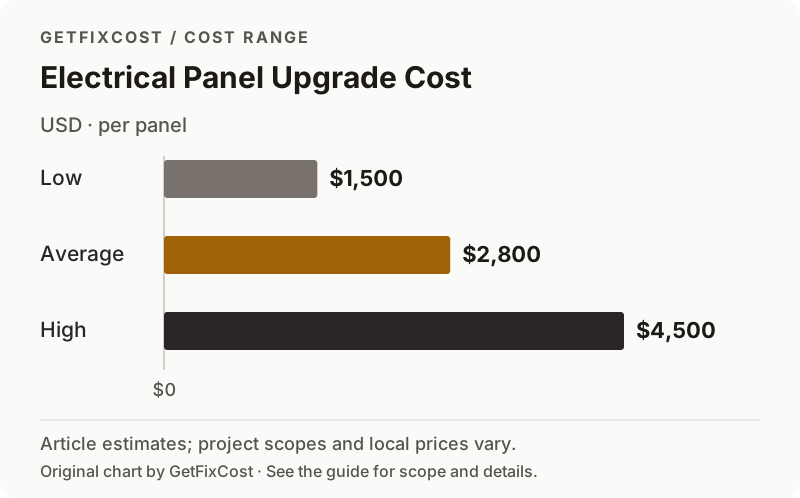
Upgrading an electrical panel in the United States typically costs between $1,500 and $4,500, with the national average sitting at $2,800 for a full service upgrade from 100 amps to 200 amps.
A straightforward swap where existing exterior service entrance cables and meter base already support 200 amps costs between $1,300 and $1,900. More complex jobs requiring meter socket replacement, new grounding electrodes, utility disconnects, and long wire runs range from $3,200 to $4,800.
Modern homes demand far more electricity than older properties were designed to handle. Central heat pumps, electric car chargers, induction cooktops, and home electronics push older 60-amp and 100-amp panels past safe operating thresholds. Upgrading to a modern 200-amp panel provides sufficient breaker space and ampacity for decades to come.
Quick-Reference Cost Table
| Upgrade Scope | Typical Cost Range | Electrician Labor Time | Key Hardware Included | Recommended Scenario |
|---|---|---|---|---|
| Same-Location 100A to 150A | $1,200 – $2,200 | 4 – 6 Hours | 30-space panel, main breaker | Smaller homes with gas appliances |
| Standard 100A to 200A Upgrade | $1,800 – $3,500 | 6 – 8 Hours | 200A panel, meter base, ground rods | Single-family homes adding AC or EV |
| Relocating Service Panel | $2,800 – $4,800 | 8 – 12 Hours | Junction sub-panel, conduit, feeders | Moving panel out of closet/bathroom |
| Heavy-Up to 400A Service | $4,500 – $7,500 | 12 – 16 Hours | Dual 200A panels or 400A meter-main | Homes over 3,500 sq ft, dual EV chargers |
| Fuse Box to Breakers | $2,200 – $3,800 | 6 – 10 Hours | Full panel conversion, circuit tracing | Older homes needing insurance approval |
Cost Factors That Impact Total Pricing
Several technical and regulatory variables determine your total electrical panel invoice:
- Amperage Capacity: Moving from 100 amps to 200 amps requires heavy 2/0 copper or 4/0 aluminum entrance conductors. Moving up to 400 amps requires dual panels and commercial-grade utility transformers.
- Meter Base Replacement: The National Electrical Code (NEC) often mandates upgrading the exterior meter housing and weatherhead mast if clearances fail modern height standards, adding $350 to $800.
- Grounding System Upgrades: Modern code requires two 8-foot copper ground rods driven into the soil and bonding to interior copper water lines, costing $200 to $450.
- AFCI & GFCI Breakers: Modern building codes require Arc-Fault Circuit Interrupter (AFCI) breakers on bedroom and living circuits. Standard breakers cost $8 to $12 each, while AFCI/GFCI breakers run $45 to $65 each, adding $500 to $1,200 across 20 to 30 circuits.
- Panel Clearance & Relocation: The NEC requires a 30-inch-wide by 36-inch-deep clear workspace in front of the panel. If your existing panel is in a closet or bathroom, relocating it to a garage or utility room adds significant rewiring labor.
Regional Cost Variations Across the US
Local labor wages and utility requirements create noticeable pricing differences:
- West Coast (CA, WA, OR): High electrician wages ($110–$160/hr) and strict Title 24 regulations place typical 200A upgrades at $2,800 to $4,500.
- Northeast (NY, MA, PA): Older housing stock, dense urban basements, and high permit fees yield averages of $2,500 to $4,000.
- Midwest (OH, IL, MI): Moderate contractor rates ($75–$110/hr) and accessible basements keep costs around $1,800 to $3,200.
- Southeast & Texas (FL, NC, TX): Competitive labor rates result in averages of $1,600 to $2,800, though storm-resistant exterior meter enclosures may add cost in coastal regions.
Repair vs. Replace: How to Decide
Use these guidelines to evaluate whether your panel needs repairs or replacement:
- When to Repair or Add a Subpanel: If your main breaker box is a modern Square D, Eaton, or Siemens panel under 15 years old with sound bus bars, installing an auxiliary 60A to 100A subpanel ($500 to $1,100) is far more cost-effective than replacing the whole box.
- When to Replace Immediately: Homes with Federal Pacific Electric (Stab-Lok) or Zinsco panels must replace them immediately. Independent safety testing shows their breakers fail to trip under direct overloads up to 60% of the time, presenting extreme fire hazards.
- The 50% Rule: If repairing damaged bus bars, main breakers, and obsolete components costs more than half of a new 200A panel, replace the entire system.
DIY vs. Hiring a Professional & Safety Warnings
Replacing an electrical service panel is strictly a task for licensed master electricians.
Service drop conductors entering the meter box connect directly to the street transformer without fuse protection. Any accidental contact with energized bus bars creates an explosive arc flash capable of causing fatal electrocution and severe thermal burns.
Professional electricians follow established safety protocols, coordinate power shutoffs with the electric utility, pull municipal trade permits, and ensure installations meet all local electrical codes to protect your home and preserve insurance coverage.
Warning Signs You Need Action Immediately
Inspect your breaker panel for these signs of wear or failure:
- Hot Panel Cover: A warm panel door or faint burning odor indicates loose connections or arcing breakers.
- Frequent Breaker Tripping: Regular tripping when operating standard household appliances signals circuit overloads.
- Rust or Corrosion: Moisture dripping down the service entrance cable into the panel corrodes bus bars and causes electrical resistance.
- Flickering Lights: Lights dimming noticeably when the air conditioner or refrigerator kicks on indicates significant voltage drop across main conductors.
- Audible Buzzing: Humming or crackling sounds from inside the enclosure indicate damaged breaker clips or arcing contacts.
Hidden Costs & Contractor Pitfalls
Be aware of these potential extras when reviewing electrical estimates:
- Utility Disconnect Fees: Electric utilities often charge $100 to $300 to disconnect and reconnect the service drop wires.
- Drywall Patching: Electricians cut access holes to fish wires but rarely repair drywall, requiring $200 to $500 for a drywall finisher.
- Whole-Home Surge Protector: Modern codes require Type 2 whole-house surge protective devices (SPDs) on new panels, adding $250 to $400.
- Trenching for Underground Lines: Converting overhead lines to underground conduit costs $1,200 to $2,500 in excavation.
How to Save Money and Vet Contractors
Follow these practical bidding strategies to protect your budget:
- Get Three Itemized Bids: Require contractors to specify panel brand, space count (choose 40-space panels), and AFCI breaker counts.
- Bundle Electrical Projects: Add planned EV charger circuits or generator transfer switches during the panel upgrade to save on separate service calls.
- Verify License and Insurance: Confirm that the contractor holds an active Master Electrician license and at least $1,000,000 in liability coverage.
- Ensure Contractor Pulls Permits: Never pull an owner-builder permit; the licensed electrician must pull the permit to guarantee accountability.
Typical Project Timeline & Process
An electrical panel upgrade follows an orderly sequence:
- Phase 1: Permitting & Utility Scheduling (1 to 2 Weeks): The electrician files permit applications and schedules a disconnect date with the utility.
- Phase 2: Installation Day (6 to 8 Hours): Power is disconnected in the morning, the old box is removed, new 200A equipment and ground rods are installed, and branch circuits are connected.
- Phase 3: Inspection & Reconnection (Afternoon): The municipal building inspector approves the work, and the utility reattaches the meter and restores power.
- Phase 4: Final Sign-off (1 to 3 Days): The city issues a certificate of final electrical inspection.
Next Steps & Estimate Checklist
Before scheduling contractor visits, complete these simple steps:
- Photograph your current breaker box, manufacturer label, and outdoor meter enclosure.
- Make a list of high-draw appliances you plan to add within the next five years.
- Schedule consultations with three licensed local electrical contractors and demand itemized written proposals.
Frequently Asked Questions
01. How much does it cost to upgrade from 100 amps to 200 amps?
02. How long does an electrical panel upgrade take?
03. Do I need to upgrade my panel if I install an EV charger or heat pump?
04. Can I replace an electrical breaker panel myself?
05. Does an electrical panel upgrade require a new electric meter?
Related Cost Guides
More in this trade →
EV Charger Installation Cost
Find out EV charger installation costs for Level 2 home charging stations, including wiring, permits, and labor.
House Rewiring Cost
Learn what whole-house rewiring costs, including permits, drywall repairs, and electrical panel upgrades.