Project Overview & Direct Cost Answer
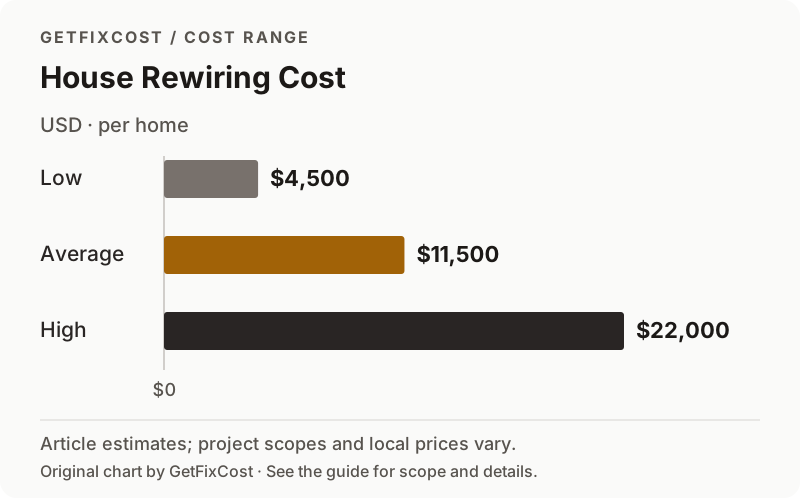
Completely rewiring a residential home in the United States typically costs between $4,500 and $22,000, with the national average centering at $11,500 for an average 2,000 square foot home.
Overall costs range from $4.00 to $9.00 per square foot. Rewiring an open-stud home during a major gut remodel or a single-story ranch home with an open attic and unfinished basement can cost as little as $4,500 to $8,000. In contrast, rewiring a multi-story historic Victorian home with lath-and-plaster walls, finished basements, and active knob-and-tube wiring frequently reaches $15,000 to $25,000+.
Rewiring represents one of the most comprehensive safety upgrades a homeowner can undertake. Replacing ungrounded, fire-prone vintage wiring with modern copper non-metallic sheathed cable (Romex NM-B) eliminates shock hazards, allows modern high-draw appliances to operate safely, and satisfies stringent insurance underwriting requirements.
Quick-Reference Cost Table
| Home Size & Wall Construction | Typical Rewiring Cost | Electrician Labor Time | Drywall / Plaster Patching | Recommended Scenario |
|---|---|---|---|---|
| Small Home (Under 1,200 Sq Ft, Drywall) | $4,500 – $8,500 | 4 – 7 Days | $800 – $1,500 | Modest ranch homes with unfinished attic |
| Medium Home (1,500–2,200 Sq Ft, Drywall) | $8,000 – $14,000 | 6 – 10 Days | $1,200 – $2,500 | 1960s–1980s homes replacing ungrounded circuits |
| Large Home (2,500–3,500 Sq Ft) | $13,000 – $22,000 | 10 – 16 Days | $2,000 – $4,000 | Multi-level homes with finished basements |
| Historic Home (Plaster & Knob-and-Tube) | $16,000 – $28,000 | 12 – 20 Days | $3,500 – $7,000 | Pre-1950 homes with lath-and-plaster walls |
| Open-Stud Full Gut Remodel | $3,500 – $7,500 | 3 – 5 Days | $0 (included in remodel) | Rewiring while all wall cavities are exposed |
Cost Factors That Impact Total Pricing
Several crucial physical and architectural factors dictate whole-house rewiring costs:
- Wall Construction (Drywall vs. Lath and Plaster): Cutting access holes in modern drywall is fast and clean. Historic homes with lath-and-plaster walls require slow, meticulous cutting to avoid cracking surrounding wall finish, increasing labor time by 40% to 60%.
- Attic and Crawl Space Accessibility: Electricians run cables through attic joists and basement/crawl space ceilings before fishing them vertically down wall cavities. Homes on concrete slabs without attics require cutting continuous horizontal channels in walls or running surface conduit.
- Panel Upgrade Included: Most rewiring projects necessitate upgrading an obsolete 60A or 100A panel to a 200A service box with dual ground rods, adding $1,800 to $3,500.
- Number of Outlets, Switches, and Fixtures: Modern electrical codes require receptacles every 12 feet along living room walls and dedicated 20A small appliance circuits in kitchens. More device boxes translate directly to more copper and labor.
- AFCI & GFCI Breaker Mandates: Current National Electrical Code (NEC) requires Arc-Fault Circuit Interrupter (AFCI) protection on virtually all living circuits, adding $500 to $1,400 in specialty circuit breakers.
Regional Cost Variations Across the US
Electrician labor rates and municipal inspection fees vary significantly across the US:
- West Coast (CA, WA, OR): High journeyman wages ($100–$150/hr) and strict energy standards place rewiring for an average home at $13,000 to $22,000.
- Northeast (NY, MA, PA): High density of pre-1940 historic housing stock with knob-and-tube wiring results in typical averages of $12,500 to $21,000.
- Midwest (IL, OH, MI): Readily accessible basements and competitive contractor markets average $8,500 to $14,500.
- South & Texas (TX, FL, GA): Lower labor rates keep typical rewiring around $7,500 to $13,000, though concrete slab foundations can increase vertical wire routing expenses.
Repair vs. Replace: How to Decide
Evaluate whether localized circuit additions or full rewiring is appropriate:
- When to Add Isolated Circuits: If your home already has grounded Romex wiring installed in the 1970s or later, but you need dedicated 240V circuits for an EV charger, induction stove, or central AC, adding dedicated home runs for $350 to $900 per circuit is completely sufficient.
- When to Rewire Completely: If home inspection reveals active knob-and-tube wiring, vintage aluminum branch circuit wiring from the late 1960s, or brittle cloth insulation that crumbles to the touch, complete rewiring is necessary to prevent electrical fires.
- The 50% Rule: If repairing intermittent circuit shorts, replacing ungrounded outlets, and fixing overloaded branch lines approaches half the cost of rewiring, replace the entire system to ensure modern code compliance.
DIY vs. Hiring a Professional & Safety Warnings
While homeowners can replace light switch faceplates or swap an existing light fixture on a de-energized circuit, whole-house rewiring is strictly a job for licensed electrical contractors.
Working with service entrance cables and distribution panels carries severe risks of fatal electrocution and arc blast explosions. Furthermore, improperly sized conductors, missing nail-strike plates, overfilled junction boxes, and unbonded grounding circuits represent hidden fire hazards that can smolder undetected inside wall cavities for weeks before igniting.
Licensed master electricians carry commercial liability insurance, pull required municipal electrical permits, understand NEC load calculation formulas, and schedule mandatory rough-in and final inspections with city building authorities.
Warning Signs You Need Action Immediately
Inspect your home for these definitive indicators of obsolete or failing wiring:
- Two-Prong Ungrounded Outlets: Indicates the electrical system lacks a dedicated ground wire, leaving modern computers, TVs, and appliances vulnerable to surge damage and shock.
- Warm Wall Outlets or Switches: Faceplates that feel warm or emit a faint burning plastic odor signal loose electrical connections or severe resistance.
- Flickering or Dimming Lights: If room lights flicker when an appliance turns on, circuits are overloaded or service entrance splices are failing.
- Frequent Breaker Tripping or Blown Fuses: Circuits regularly tripping under modest electrical loads indicate inadequate branch capacity.
- Discolored or Scorched Outlet Faceplates: Blackened plastic around receptacle slots indicates dangerous internal arcing.
Hidden Costs & Contractor Pitfalls
Carefully examine electrical rewiring proposals for these frequently excluded items:
- Drywall & Plaster Patching: Electricians cut access holes into walls and ceilings to fish wires, but patching, mudding, sanding, and painting is almost always excluded, adding $1,500 to $4,500 for a drywall contractor.
- Lead Paint or Asbestos Testing: In homes built before 1978, cutting plaster and drywall requires EPA Lead-Safe Certified work practices, adding $500 to $1,500 in containment setup.
- Smoke and Carbon Monoxide Alarms: Modern building codes require hardwired, interconnected smoke/CO detectors with battery backups in every bedroom and hallway during a rewire, adding $600 to $1,200.
- Exterior Meter & Service Mast Upgrades: Power utilities often require replacing the exterior meter socket and conduit mast, adding $500 to $1,000.
How to Save Money and Vet Contractors
Protect your home renovation budget with these practical guidelines:
- Rewire During Other Major Renovations: If you plan to renovate your kitchen, open up walls, or finish an attic, coordinate rewiring simultaneously. Exposing wall framing saves 30% to 50% in wire fishing labor.
- Combine with Panel and Service Upgrades: Upgrading your panel and service entrance at the same time saves on separate permit and mobilization fees.
- Handle Wall Patching Preparation: If you have basic DIY skills, hanging sheetrock over cutouts and applying initial mud coats can save thousands in finisher labor.
- Demand Itemized Written Quotes: Require contractors to specify wire gauge (12 AWG for 20A circuits, 14 AWG for 15A circuits), box counts, AFCI breaker allowances, and permit fees.
Typical Project Timeline & Process
A whole-house rewiring project proceeds through these typical phases:
- Phase 1: Planning & Permitting (1 to 2 Weeks): The electrician maps circuit layouts, calculates electrical loads, and secures municipal building permits.
- Phase 2: Rough-In & Wire Fishing (5 to 10 Days): Crews cut access notches, drill joists with long flexible auger bits, fish Romex cables, mount new steel or plastic device boxes, and run home runs to the panel.
- Phase 3: Rough Inspection (1 Day): The city electrical inspector examines all exposed wiring, box connections, and nail-guard plates before walls are closed.
- Phase 4: Trim-Out & Final Testing (2 to 4 Days): Switches, tamper-resistant receptacles, light fixtures, and breaker panels are terminated and tested with digital circuit analyzers for polarity and grounding. ze in wiring; wall patching is typically handled by a separate drywall contractor or painter.
- Can I rewire one room at a time? Yes, phased rewiring is possible, though doing the entire home at once is 20% to 30% cheaper overall.
- Will new wiring increase home value? Yes, updated wiring provides peace of mind, satisfies buyer home inspections, and eliminates insurance obstacles.
Next Steps & Estimate Checklist
Before scheduling electrician walkthroughs, complete this preparation checklist:
- Take an inventory of all rooms, noting two-prong outlets and non-working switches.
- Determine whether your panel is 100A or 200A and locate your attic and crawl space access hatches.
- Solicit three comprehensive in-home quotes from licensed, insured electrical contractors.
Frequently Asked Questions
01. How much does it cost to rewire a house on average?
02. How much does rewiring cost per square foot?
03. Can you live in the house while it is being rewired?
04. Why is knob-and-tube wiring dangerous?
05. Does homeowners insurance require rewiring older homes?
Related Cost Guides
More in this trade →
Electrical Panel Upgrade Cost
Learn what electrical panel upgrades cost, from 100-amp to 400-amp service, including permits and electrician rates.
EV Charger Installation Cost
Find out EV charger installation costs for Level 2 home charging stations, including wiring, permits, and labor.