Project Overview & Direct Cost Answer
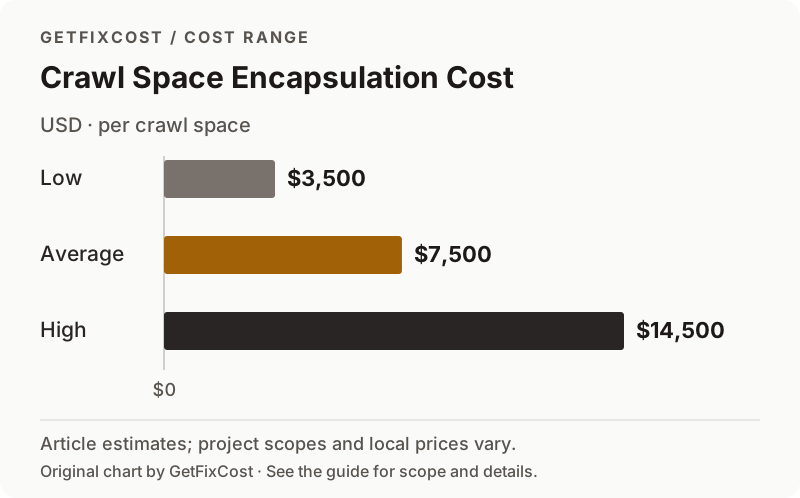
Encapsulating a residential crawl space in the United States typically costs between $3,500 and $14,500, with the national average centering at $7,500 for a standard 1,200 to 1,500 square foot crawl space.
Costs average $3.00 to $8.00 per square foot. A basic moisture mitigation project on a clean, dry crawl space involving a 12-mil vapor barrier and vent sealing can cost as little as $3,500 to $5,000. Conversely, comprehensive encapsulation on a wet, neglected crawl space requiring standing water removal, mold remediation, interior French drainage, a sump pump, 20-mil reinforced antimicrobial liner, rigid wall foam insulation, and a commercial dehumidifier ranges from $9,000 to $16,000+.
Traditional open, vented crawl spaces are flawed building science. In humid summer months, hot outside air enters foundation vents and condenses against cool air conditioning ducts and floor joists, breeding wood-rot fungus and toxic mold. Encapsulation seals the crawl space into a clean, dry, conditioned envelope that preserves structural floor joists, improves indoor air quality, and lowers energy bills.
Quick-Reference Cost Table
| Encapsulation Component / Scope | Average Cost Range | Typical Lifespan | Primary Function | Necessity Level |
|---|---|---|---|---|
| Heavy Vapor Barrier (12–20 Mil Taped) | $2.50 – $4.50 / Sq Ft | 20 – 30+ Years | Blocks soil moisture & radon gas | Mandatory for all encapsulations |
| Commercial Dehumidifier (70–100 Pint) | $1,200 – $2,200 Installed | 8 – 12 Years | Keeps relative humidity below 55% | Mandatory in sealed crawl spaces |
| Exterior Vent & Rim Joist Air Sealing | $400 – $900 | Lifetime | Stops hot humid air infiltration | Mandatory to seal thermal envelope |
| Rigid Foam Board Wall Insulation | $1.50 – $3.50 / Sq Ft Wall | 25 – 40 Years | Insulates masonry foundation walls | Recommended for cold/mixed zones |
| Sump Pump & French Drain Addition | $2,000 – $4,500 | 10 – 20 Years | Removes active pooling groundwater | Mandatory if standing water occurs |
| Wood Mold Remediation Spray | $800 – $2,500 | 5 – 10 Years | Kills active fungus on joists | Mandatory if mold is present |
Cost Factors That Impact Total Pricing
Several environmental and physical variables determine crawl space encapsulation costs:
- Crawl Space Height & Accessibility: Working in a spacious 4-foot to 5-foot crawl space is relatively fast. Squeezing through an 18-inch access hatch into a cramped 24-inch crawl space with low joists slows technicians down, increasing labor by 25% to 40%.
- Liner Thickness (Mil Rating): Thin 6-mil plastic tears easily and degrades within years ($0.50/sq ft). Heavy-duty 12-mil to 20-mil multi-ply reinforced polyethylene with polyester string reinforcement resists punctures from crawling and rocks, costing $1.50 to $3.50 per square foot in materials.
- Ground Preparation & Debris Removal: Clearing decades of discarded construction scraps, sharp rocks, old fallen fiberglass insulation, and leveling soil ruts adds $500 to $1,500 in manual labor.
- Active Standing Water & Drainage: If groundwater pools on the dirt floor during rains, an interior perforated pipe trench and sump pump basin must be installed before laying plastic, adding $2,000 to $4,500.
- Commercial Grade Dehumidifier: Installing an Energy Star self-draining crawl space dehumidifier (such as AprilAire or Santa Fe) with digital humidistat controls adds $1,200 to $2,200.
Regional Cost Variations Across the US
Climate humidity and regional building practices dictate project costs:
- Southeast & Mid-Atlantic (NC, GA, VA, SC): Hot, humid summers create extreme crawl space condensation, making complete encapsulation with heavy dehumidifiers standard, averaging $6,500 to $11,500.
- Midwest (IL, IN, OH, MO): Freeze-thaw cycles and seasonal rainfall require heavy rigid foam wall insulation and perimeter drain tiles, averaging $6,000 to $10,500.
- Pacific Northwest (WA, OR): Continuous damp winters require specialized fungal remediation and robust vapor barriers, averaging $7,000 to $12,500.
- Texas & South (TX, AL, MS): Shorter crawl space heights and high humidity result in typical averages of $5,500 to $9,500.
Repair vs. Replace: How to Decide
Evaluate your crawl space moisture conditions with these benchmarks:
- When a Simple 6-Mil Dirt Cover is Insufficient: Tossing loose, unsealed 6-mil plastic on the dirt floor while leaving foundation vents open does not stop moisture evaporation. Soil moisture evaporates, travels around the plastic edges, and condenses on subfloors.
- When Full Encapsulation is Essential: If your home smells musty, hardwood floors above are cupping, floor joists show white or black fungal growth, or fiberglass batts are falling from joist bays like wet sponges, full encapsulation is necessary.
- The 50% Rule: If recurring mold treatments, sagging subfloor repairs, and pest extermination bills exceed half the cost of complete encapsulation, seal the crawl space to permanently solve moisture issues.
DIY vs. Hiring a Professional & Safety Warnings
Laying an unsealed plastic tarp in a clean crawl space is an approachable DIY task, but complete encapsulation requires professional trade equipment.
Crawling in confined, unconditioned sub-floor spaces exposes workers to severe biohazards, including toxic mold spores (Stachybotrys and Cladosporium), hantavirus from rodent droppings, brown recluse spiders, and raw sewage from leaking waste pipes. Furthermore, installing non-permeable vapor barriers without proper combustion air ventilation can backdraft gas furnaces and water heaters, creating lethal carbon monoxide hazards.
Professional crawl space contractors wear full Tyvek protective suits and full-face respirators, test for radon gas, wrap support piers meticulously with specialized polyurethane sealants, and guarantee relative humidity below 55%.
Warning Signs You Need Action Immediately
Inspect your home for these telltale signs of crawl space moisture failure:
- Cupped or Squeaky Hardwood Floors: Hardwood floor planks bowing upward at the edges indicate high humidity in the crawl space expanding the underside of flooring.
- Persistent Musty Odors in Living Areas: Due to the “stack effect,” 50% of the air on your first floor originated in the crawl space. Musty odors signal fungal growth beneath.
- Falling or Soaked Fiberglass Insulation: Fiberglass batts in floor joists absorb moisture, become heavy, and drop to the dirt floor in wet clumps.
- Visible Mold on Joists and Subflooring: White fuzzy growth or black spots across wooden floor framing indicates wood-decaying fungus.
- High Indoor Summer Humidity: Inability to keep indoor humidity below 60% despite continuous air conditioning operation indicates crawl space moisture infiltration.
Hidden Costs & Contractor Pitfalls
Review encapsulation estimates to ensure these commonly excluded items are covered:
- Electrical Circuit for Dehumidifier: Dehumidifiers require a dedicated 15-amp or 20-amp outlet. If none exists, an electrician must wire one for $250 to $500.
- Pest Extermination: Eliminating active termite colonies or rodent infestations before sealing adds $400 to $1,200.
- Radon Mitigation Integration: If radon is present, the vapor barrier must be sealed airtight and connected to an active sub-membrane exhaust fan ($800 to $1,500).
- Structural Wood Rot Sistering: Replacing or sistering rotted floor joists and rim boards costs $100 to $250 per joist.
How to Save Money and Vet Contractors
Protect your home investment budget with these practical guidelines:
- Clean Out Debris Yourself: Removing old cardboard, discarded lumber, and trash before the crew arrives can reduce labor prep fees by $300 to $600.
- Insist on Minimum 12-Mil Reinforced Liner: Never accept cheap 6-mil black plastic. Insist on minimum 12-mil (ideally 20-mil) multi-ply reinforced white polyethylene.
- Verify Sealed Wall Attachments: Ensure the liner is fastened mechanically with masonry fasteners and sealed airtight with polyurethane acoustic mastic 6 inches above the outside soil line.
- Obtain Three Itemized Bids: Require bids to specify liner thickness, dehumidifier brand/pint capacity, warranty terms, and drainage scope.
Typical Project Timeline & Process
A professional crawl space encapsulation project takes 2 to 4 days:
- Phase 1: Clearing & Regrading (Day 1): Debris, old falling insulation, and rocks are removed. Soil is raked smooth, and mold remediation spray is applied to wooden joists.
- Phase 2: Drainage & Vent Sealing (Day 2): Interior perimeter drainage pipe and sump pump are installed if needed. Exterior foundation vents are sealed with insulated covers.
- Phase 3: Vapor Barrier Installation (Days 2 to 3): Heavy 20-mil liner is rolled across the ground, wrapped up foundation walls and support piers, fastened with masonry pins, and sealed with waterproof tape.
- Phase 4: Dehumidifier & Monitoring (Day 4): The commercial dehumidifier is suspended from floor joists, plumbed to a drain, wired, and digital wireless humidity monitors are configured.
Next Steps & Estimate Checklist
Before scheduling crawl space contractor consultations:
- Inspect your crawl space entrance hatch and verify access dimensions.
- Check first-floor rooms for floor cupping, sagging spots, or musty smells.
- Request written itemized quotes from three licensed foundation and crawl space specialists.
Frequently Asked Questions
01. How much does crawl space encapsulation cost on average?
02. How much does crawl space encapsulation cost per square foot?
03. What is included in full crawl space encapsulation?
04. Does crawl space encapsulation lower heating and cooling bills?
05. How long does crawl space encapsulation last?
Related Cost Guides
More in this trade →
Basement Waterproofing Cost
Learn typical basement waterproofing costs by method, including interior drainage, exterior excavation, and sealant options.
Foundation Repair Cost
Get realistic foundation repair costs by method: push piers, carbon fiber straps, epoxy injection, and I-beam bracing.
Foundation Cracks: Which Are Worth Fixing?
Learn when foundation cracks are worth fixing, including severity assessments and repair cost comparisons.