Project Overview & Direct Cost Answer
Determining whether a foundation crack is worth fixing depends on three objective criteria: crack width, direction of the fracture, and whether active water or wall displacement is present.
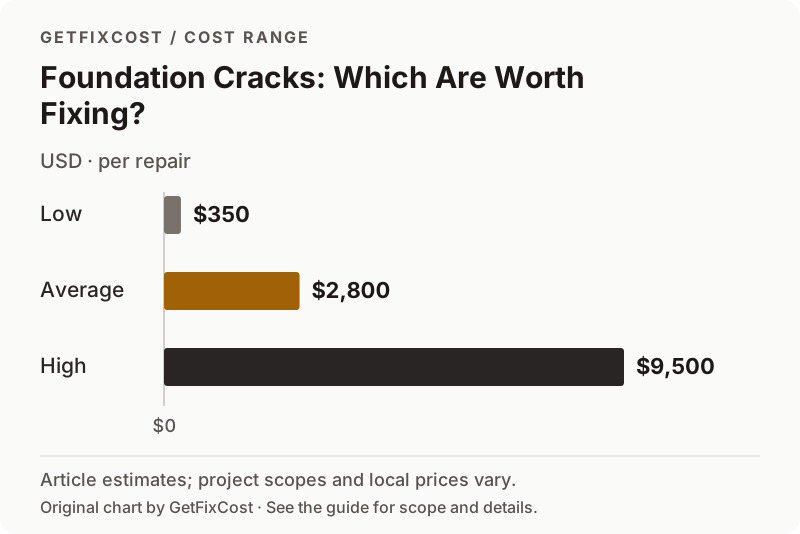
Minor cosmetic repairs—such as injecting an expanding polyurethane foam or structural epoxy into a non-moving hairline vertical crack to stop water seepage—typically cost between $350 and $800 per crack. In contrast, structural remediation for bowing basement walls or sinking foundation footers using carbon fiber reinforcement straps, heavy steel I-beam braces, or steel helical piers ranges from $2,500 to $12,500+.
Not every crack in a concrete foundation represents an impending structural disaster. When newly poured concrete cures, it loses moisture and naturally shrinks, creating hairline surface fissures. However, horizontal cracks, stair-step masonry fractures, or cracks wider than 1/4 inch signal active soil movement and structural foundation distress that must be stabilized immediately to prevent wall collapse and total loss of property value.
Quick-Reference Cost Table
| Crack Type & Orientation | Width & Symptoms | Typical Repair Cost | Danger Level | Recommended Solution |
|---|---|---|---|---|
| Hairline Vertical Shrinkage | < 1/16 Inch, No Leaks | $0 – $150 (DIY Sealant) | Very Low (Cosmetic) | Monitor with pencil marks; caulk if desired |
| Leaking Vertical Crack | 1/16 to 1/8 Inch, Water Weeping | $350 – $800 / Crack | Moderate (Water Hazard) | High-pressure polyurethane foam injection |
| Stair-Step Crack in Block Wall | 1/8 to 1/4 Inch Along Mortar | $1,200 – $3,500 | High (Differential Settling) | Carbon fiber stitching or helical underpinning |
| Horizontal Crack in Wall | Any width, inward wall bowing | $2,500 – $6,500 | Critical (Structural Collapse) | Carbon fiber straps or steel I-beam braces |
| Corner Diagonal Crack (Stepping) | > 1/4 Inch, doors sticking | $4,500 – $14,000 | Critical (Foundation Sinking) | Hydraulic push piers to bedrock footers |
Cost Factors That Impact Total Pricing
Several crucial engineering and physical factors dictate foundation repair costs:
- Crack Orientation & Structural Threat: Vertical hairline cracks are usually shrinkage-related and cheap to seal ($350–$600). Horizontal cracks mean outside soil is pushing the wall inward, requiring structural carbon fiber straps ($400 to $800 per strap, spaced every 4 feet) or steel I-beams ($700 to $1,400 per beam).
- Settlement & Number of Piers Required: If a foundation corner has dropped due to soil subsidence, hydraulic push piers or helical screw piers must be driven to bedrock. Underpinning costs $1,500 to $3,000 per pier, with most sinking corners requiring 4 to 8 piers.
- Accessibility (Interior vs. Exterior): Repairing cracks from inside an unfinished basement is fast. If cracks are covered by finished drywall, framing, and mechanical equipment, demolition adds $500 to $1,500.
- Structural Engineering Inspection: Before spending thousands on foundation stabilization, hiring an independent licensed structural engineer (PE) to measure floor elevations and write an unbiased report costs $400 to $800.
- Hydrostatic Drainage Correction: If exterior water pressure caused the cracking, the underlying water problem must be resolved with exterior regrading, downspout extensions, or French drains ($1,500 to $5,000).
Regional Cost Variations Across the US
Geographic soil geology and climate cycles heavily impact foundation crack severity:
- Texas & Sunbelt (TX, OK, KS): Expansive black clay soils swell dramatically when wet and shrink into deep fissures during summer droughts, making pier underpinning common, averaging $4,500 to $12,000.
- Midwest (IL, OH, MO, WI): Freeze-thaw cycles and heavy clay backfill cause horizontal wall bowing, with carbon fiber strap installations averaging $3,500 to $7,500.
- Northeast (PA, NY, NJ): Older unreinforced stone and hollow cinder block foundations require structural carbon fiber stitching and masonry tuckpointing, averaging $3,200 to $6,800.
- Southeast & Florida (FL, GA, SC): Sandy soils and high water tables cause localized footer sinkholes, averaging $4,000 to $9,500 for underpinning.
Repair vs. Replace: How to Decide
Use this systematic engineering checklist to evaluate your foundation cracks:
- When to Simply Monitor: If a vertical crack is thinner than a penny (under 1/16 inch), does not leak water during torrential rains, and both sides of the concrete face are perfectly flush, date-stamp the crack with a pencil. Check it every 6 months. If it does not widen, no repair is needed.
- When to Inject Foam or Epoxy: If a vertical or diagonal crack leaks water into the basement but exhibits no wall movement or displacement, high-pressure polyurethane injection ($400 to $800) stops water permanently while remaining flexible.
- When Structural Reinforcement is Non-Negotiable: If a horizontal crack is visible along mortar joints, a concrete wall has bowed inward more than 1 inch, or interior drywall cracks align with sticking second-story doors, structural reinforcement (carbon fiber, steel beams, or piers) must be installed immediately.
DIY vs. Hiring a Professional & Safety Warnings
Homeowners can safely monitor non-structural hairline cracks using a plastic crack-monitor gauge ($20) or apply hydraulic cement to small surface chips.
However, structural foundation repair must be handled by certified foundation repair contractors.
A bowing or settling foundation wall supports the entire structural dead load of your home (often 30 to 50 tons of framing, brick, roofing, and interior finishes). Installing DIY braces improperly or ignoring horizontal cracks risks sudden catastrophic wall shear during heavy rainstorms when soil saturation peaks. Furthermore, underpinning sinking footers requires 10,000-PSI hydraulic rams to drive heavy steel pipe through unstable soil to solid bedrock.
Warning Signs You Need Action Immediately
Watch for these critical warnings that a foundation crack is structurally active:
- Horizontal Cracks Along Foundation Walls: A continuous horizontal fracture running midway up a basement wall signals severe lateral hydrostatic earth pressure pushing the wall inward.
- Stair-Step Cracks in Masonry or Exterior Brick: Stepping cracks following the mortar joints of concrete blocks or exterior brick indicate differential foundation settlement.
- Sheared or Inward-Bowing Walls: Looking down the length of a foundation wall, if the middle bows inward or the bottom block shears inward along the floor, failure is imminent.
- Doors and Windows Sticking Throughout the Home: When foundation corners sink, door frames torque out of square, causing doors to jam and diagonal drywall cracks to radiate from door corners.
- Gaps Between Walls and Ceilings or Floors: Noticeable separations between baseboards and flooring indicate structural floor joist shifting.
Hidden Costs & Contractor Pitfalls
Watch for these commonly overlooked expenses in foundation repair bids:
- Structural Engineer Consultation: Never rely solely on a foundation repair salesman’s assessment; an independent structural engineer’s signed report costs $400 to $800 and provides an unbiased repair scope.
- Excavation Obstructions (HVAC, Decks, Concrete): Driving exterior helical piers beneath air conditioning condensers, porches, or concrete patios requires temporary removal fees ($500 to $1,500).
- Interior Drywall & Trim Demolition: Accessing foundation walls in finished basements adds $500 to $1,500 in carpentry and drywall demolition.
- City Permits & Geotechnical Testing: Municipal structural building permits and soil boring tests cost $200 to $600.
How to Save Money and Vet Contractors
Protect your home equity and budget with these proven strategies:
- Hire an Independent Structural Engineer First: Paying $500 for an independent engineer prevents falling for high-pressure sales tactics recommending $15,000 in unnecessary piers when a $600 crack injection is all that is needed.
- Address Exterior Drainage Immediately: 90% of foundation cracks are caused by soil saturation. Cleaning gutters, extending downspouts 10 feet away, and regrading soil slope saves thousands by stopping hydrostatic pressure.
- Choose Carbon Fiber Over Steel Beams Where Feasible: If wall bowing is under 2 inches, carbon fiber straps provide 10 times the tensile strength of steel, install flush without eating into room space, and cost 30% to 40% less.
- Obtain Three Written Bids: Require bids to specify pier depth warranties, steel gauge, carbon fiber manufacturer (such as Fortress or Rhino), and transferable lifetime warranties.
Typical Project Timeline & Process
A professional foundation crack repair or stabilization proceeds as follows:
- Phase 1: Engineering Assessment & Laser Mapping (Day 1): The engineer or specialist maps foundation elevations with a zip-level altimeter and marks crack widths.
- Phase 2: Surface Preparation & Drilling (Day 1 to 2): For carbon fiber or epoxy, walls are ground smooth to bare concrete. For piers, small exterior pits are excavated to the footer.
- Phase 3: Installation & Driving (Days 2 to 3): Epoxy ports are injected under high pressure, carbon fiber straps are bonded with structural epoxy, or hydraulic piers are driven to load-bearing bedrock.
- Phase 4: Final Lift & Cleanup (Day 3 to 4): Sinking foundations are hydraulically stabilized or gently lifted toward level, and excavation pits are backfilled and compacted. zontal cracks, stair-step cracks, and cracks wider than 1/4 inch with uneven edges indicate serious structural movement.
- How much does it cost to fix a foundation crack? Non-structural injections cost $350 to $800; structural carbon fiber straps or piers cost $2,500 to $12,500+.
- Can a cracked foundation be permanently fixed? Yes; high-pressure epoxy and carbon fiber reinforcement permanently restore structural integrity and stop water leaks.
- Will foundation cracks hurt home resale value? Unrepaired cracks scare home buyers and complicate mortgage financing; professionally repaired cracks backed by transferable warranties protect value.
- Do foundation cracks get worse over time? Yes; seasonal freeze-thaw cycles and soil moisture fluctuations cause untreated active cracks to widen over time.
Next Steps & Estimate Checklist
Before hiring a foundation repair contractor:
- Measure all visible foundation cracks with a ruler and note if one side of the crack is offset or bulging.
- Check whether exterior downspouts are discharging water within 5 feet of foundation walls.
- Consider hiring an independent licensed structural engineer for an unbiased evaluation before soliciting bids from foundation repair companies.
Frequently Asked Questions
01. How do I know if a foundation crack is serious?
02. Are hairline foundation cracks normal?
03. How much does it cost to repair a foundation crack?
04. What is the most dangerous type of foundation crack?
05. Does homeowners insurance cover foundation crack repairs?
Related Cost Guides
More in this trade →
Basement Waterproofing Cost
Learn typical basement waterproofing costs by method, including interior drainage, exterior excavation, and sealant options.
Crawl Space Encapsulation Cost
Understand crawl space encapsulation costs for vapor barriers, insulation, dehumidifiers, and full structural upgrades.
Foundation Repair Cost
Get realistic foundation repair costs by method: push piers, carbon fiber straps, epoxy injection, and I-beam bracing.