Project Overview & Direct Cost Answer
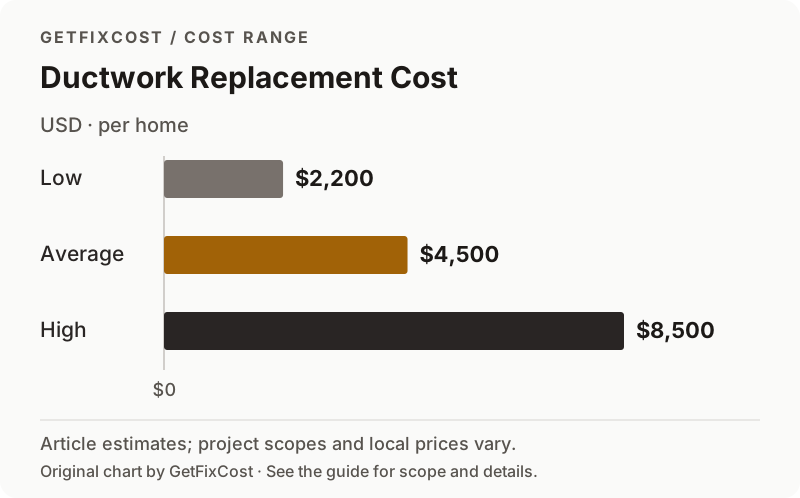
Replacing the HVAC ductwork in a residential home in the United States typically costs between $2,200 and $8,500, with the national average centering at $4,500 for a standard 1,500 to 2,000 square foot single-family home.
Overall installed costs average $15 to $35 per linear foot, or $1,500 to $3,000 per HVAC zone. A straightforward replacement of accessible flexible duct runs in an open attic or unfinished basement starts between $2,200 and $3,800. In contrast, custom fabricated rigid galvanized sheet metal duct systems in multi-story homes requiring drywall drop-ceiling chases range from $6,500 to $12,000+.
Ductwork is the circulatory system of your home’s heating and cooling. Even the most advanced 20 SEER2 heat pump or 98% AFUE furnace cannot perform efficiently if connected to crushed, disconnected, or leaking ducts. Replacing damaged ductwork restores balanced room airflow, eliminates cold spots, prevents attic dust infiltration, and lowers monthly energy bills by 20% to 30%.
Quick-Reference Cost Table
| Ductwork Material & Scope | Average Cost Per Linear Foot | Typical 150-Foot Home Cost | Expected Lifespan | Primary Benefit |
|---|---|---|---|---|
| Flexible Insulated Duct (R-6 to R-8) | $15 – $25 / Foot | $2,250 – $3,750 | 15 – 25 Years | Most affordable, easy routing around rafters |
| Rigid Galvanized Sheet Metal | $25 – $45 / Foot | $3,750 – $6,750 | 30 – 50+ Years | Maximum airflow efficiency, cannot be crushed |
| Fiberglass Duct Board System | $20 – $35 / Foot | $3,000 – $5,250 | 20 – 30 Years | Built-in acoustic sound absorption |
| Return Air Drop & Plenum Replacement | $400 – $900 / Unit | $600 – $1,400 (Add-On) | 30+ Years | Restores proper static pressure to blower |
| Aeroseal Duct Sealing Only | $1,200 – $2,500 Total | $1,200 – $2,500 (No New Ducts) | 10 – 15 Years | Seals hidden leaks without replacing pipes |
Cost Factors That Impact Total Pricing
Several crucial factors determine your total ductwork replacement estimate:
- Duct Material (Flex vs. Sheet Metal): Flexible insulated ducting is fast to install ($15–$25/ft). Rigid galvanized steel ductwork requires custom sheet metal tin-knock fabrication, dampers, and insulation wrap ($25–$45/ft), but provides superior longevity and airflow.
- Attic & Crawl Space Accessibility: Replacing ducts in an open, walkable attic or high-ceiling basement is fast. Squeezing through a cramped 24-inch crawl space or low attic with blown-in cellulose insulation increases labor time by 30% to 50%.
- Number of Supply Runs & Vents: The number of supply registers and return grilles dictates labor. Replacing 10 to 14 branch runs in an average home requires hundreds of feet of ducting, start collars, and boots.
- Insulation R-Value Standards: Modern building energy codes mandate minimum R-6 to R-8 insulation on ductwork located in unconditioned spaces (attics and crawl spaces) to prevent condensation and thermal loss.
- Duct Static Pressure Optimization: Sizing ducts correctly using ACCA Manual D calculations ensures balanced static pressure, preventing noisy whistling registers and blower motor burnout.
Regional Cost Variations Across the US
HVAC technician wages and regional architectural styles influence duct replacement bids:
- West Coast (CA, WA, OR): Strict Title 24 duct leakage testing mandates (requiring less than 4% total duct leakage) and high technician wages place averages at $4,800 to $8,500.
- Southern Sunbelt (TX, FL, AZ): Attics frequently reach 130°F+ in summer, degrading flex duct plastic rapidly and making attic replacements common, averaging $3,500 to $6,200.
- Northeast (NY, MA, PA): Older multi-story homes with tight vertical wall cavities require complex custom sheet metal transitions, averaging $4,500 to $7,800.
- Midwest (IL, OH, MI): Readily accessible basement supply and return trunks keep average replacements around $3,200 to $5,400.
Repair vs. Replace: How to Decide
Determine whether targeted duct sealing or complete duct replacement is appropriate:
- When to Seal and Insulate: If your ductwork is rigid sheet metal under 20 years old and physically intact, but suffers from air leaks at joints, professional mastic sealing or Aeroseal aerosol duct sealing costing $1,000 to $2,200 will seal 90%+ of leaks without tearing out ducts.
- When to Replace Completely: If flex ducts have ripped outer vapor barriers, soaked insulation from condensation, crushed runs from storage boxes, rodent contamination, or interior mold infestation, complete replacement is mandatory.
- The 50% Rule: If repairing disconnected runs, replacing crushed branches, and sanitizing rodent damage exceeds half the cost of a modern R-8 duct system, replace the entire ductwork layout.
DIY vs. Hiring a Professional & Safety Warnings
While homeowners can easily replace supply register grilles or apply foil-backed mastic tape to visible joints in a basement, whole-home duct replacement requires licensed HVAC professionals.
Attics contain serious hazards, including exposed wiring, stepping through drywall ceilings, and breathing airborne fiberglass and rodent droppings (hantavirus risks). Furthermore, improper duct sizing alters the system’s static pressure; undersized return ducts starve the furnace or heat pump of air, causing high-limit switches to trip, evaporator coils to freeze into solid ice, and compressors to burn out prematurely.
Licensed HVAC technicians perform ACCA Manual D airflow calculations, properly support flex ducts every 4 feet without sags or kinks, and verify duct tightness using calibrated duct-blaster pressure testing equipment.
Warning Signs You Need Action Immediately
Watch for these definitive symptoms of ductwork failure:
- Uneven Room Temperatures: One bedroom remaining freezing in winter or sweltering in summer while others are comfortable indicates detached or crushed duct runs.
- Excessive Dust and High Utility Bills: Leaking return ducts pull dusty, dirty unconditioned attic air into your HVAC system, distributing dust throughout your living spaces.
- Whistling or Rattling Airflow Sounds: High-pitched whistling sounds indicate undersized ductwork struggling against high static pressure.
- Musty or Moldy Odors When HVAC Runs: Moisture condensing inside uninsulated ducts in humid attics breeds mold that blows directly into living rooms.
- Visible Collapsed or Kinked Flex Ducts: Shiny foil ducts sagging between rafters or crushed by stored luggage restrict 50% to 70% of airflow.
Hidden Costs & Contractor Pitfalls
Carefully examine HVAC contractor proposals for these commonly excluded items:
- Duct Blaster Pressure Testing: Many municipalities require post-installation duct-blaster leakage testing to verify code compliance, costing $200 to $400.
- Drywall Soffit & Ceiling Access: In multi-story homes without attics, opening drywall chases and patching ceilings adds $500 to $1,500.
- Return Air Enlargement: Adding an extra return air grille in a master bedroom to eliminate pressure imbalances adds $300 to $600.
- Asbestos Transite Duct Abatement: Vintage in-slab transite pipe or asbestos tape around duct joints requires certified environmental abatement ($1,000 to $3,000).
How to Save Money and Vet Contractors
Protect your heating and cooling budget with these practical guidelines:
- Replace Ducts When Replacing HVAC Equipment: Combining duct replacement with a new heat pump or AC system saves $1,000 to $2,000 in combined labor and allows optimal airflow matching.
- Insist on R-8 Duct Insulation: Ensure all ducts in unconditioned attics carry minimum R-8 insulation. R-6 insulation is thinner and prone to summer condensation sweating.
- Demand Mastic Paste Over Duct Tape: Never allow installers to seal joints with standard fabric duct tape, which dry-rots and fails within 2 to 3 years. Insist on fiber-reinforced mastic paste or UL 181-rated aluminum foil tape.
- Obtain Three Itemized Quotes: Require bids to specify linear footage, R-value, number of supply runs, return sizing, and permit fees.
Typical Project Timeline & Process
A standard residential ductwork replacement proceeds through these steps:
- Phase 1: Design & Sizing (1 to 2 Days): The technician inspects the attic, calculates room CFM requirements, and designs the branch layout.
- Phase 2: Demolition & Removal (Day 1): Old crushed ducts, rusted boots, and contaminated materials are bagged, removed, and hauled away.
- Phase 3: New Trunk & Branch Installation (Days 2 to 3): New plenums are fabricated, rigid or flex ducts are suspended with 1.5-inch nylon straps, boots are sealed to ceiling drywall, and dampers are installed.
- Phase 4: Sealing & Air Balancing (Day 3 Afternoon): All joints are sealed with thick mastic paste, registers are installed, and airflow CFM is balanced with an anemometer flow hood. zed correctly, R-8 flex duct performs very well at half the cost of metal.
- Does new ductwork lower energy bills? Yes; eliminating leaks and thermal loss lowers monthly heating and cooling bills by 20% to 30%.
- How do I know if my ducts are leaking? Signs include high dust levels, hot and cold rooms, high electric bills, and whistling sounds.
Next Steps & Estimate Checklist
Before scheduling HVAC contractor consultations:
- Take note of rooms that are chronically too hot or too cold.
- Inspect your attic or crawl space if accessible and photograph visible duct runs.
- Request written itemized quotes from three licensed HVAC contractors specifying R-8 insulation and mastic sealing.
Frequently Asked Questions
01. How much does it cost to replace ductwork on average?
02. How much does ductwork cost per linear foot installed?
03. How long does residential ductwork last?
04. Can leaking ductwork really waste that much energy?
05. Can you replace ductwork without tearing down walls?
Related Cost Guides
More in this trade →
Central AC Replacement Cost
Find out what central AC replacement costs, including unit prices, installation labor, and regional variations across the US.
Furnace Replacement Cost
Learn furnace replacement costs by efficiency rating, fuel type, and system size for residential heating systems.
Heat Pump Installation Cost
Find out heat pump installation costs for ducted and mini-split systems, including labor and refrigerant line work.