Project Overview & Direct Cost Answer
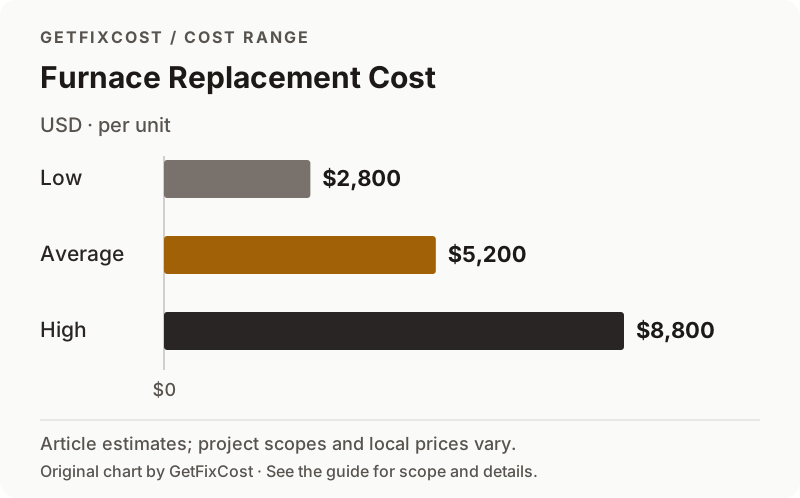
Replacing a residential furnace in the United States typically costs between $2,800 and $8,800, with the national average centering at $5,200 for a standard high-efficiency gas furnace installed in an average 2,000 square foot home.
Basic 80% AFUE standard-efficiency natural gas furnaces installed in uncomplicated basement locations can cost as little as $2,800 to $4,200. Conversely, premium two-stage or modulating variable-speed 96%+ AFUE condensing furnaces requiring new direct-vent PVC pipes through exterior rim joists range from $5,500 to $8,800. Oil-to-gas conversions or electric furnace conversions with extensive electrical heavy-ups can exceed $9,000.
Because heating accounts for roughly 45% of total household energy consumption in northern and midwestern climates, upgrading an obsolete 65% to 70% AFUE furnace to a modern condensing unit delivers substantial monthly fuel savings while eliminating dangerous cracked heat exchanger hazards.
Quick-Reference Cost Table
| Furnace Type | AFUE Efficiency Rating | Average Installed Cost | Typical Lifespan | Best Application |
|---|---|---|---|---|
| Standard Natural Gas (Single-Stage) | 80% AFUE | $2,800 – $4,200 | 15 – 20 Years | Mild southern climates, budget replacements |
| High-Efficiency Gas (Two-Stage) | 92% – 96% AFUE | $4,500 – $6,800 | 15 – 20 Years | Northern & Midwest climates, optimal value |
| Modulating Variable-Speed Gas | 97% – 98% AFUE | $6,200 – $8,800 | 18 – 22 Years | Maximum comfort, quietest continuous operation |
| Electric Resistance Furnace | 100% AFUE | $2,400 – $4,500 | 20 – 25 Years | Homes without natural gas service, mild zones |
| Oil-Fired Warm Air Furnace | 83% – 87% AFUE | $4,800 – $8,200 | 20 – 25 Years | Rural Northeast homes with oil storage tanks |
Cost Factors That Impact Total Pricing
The final price of a furnace installation depends on several mechanical and architectural elements:
- Heating Capacity (BTU Rating): Residential furnaces range from 40,000 to 120,000 BTUs. Larger homes in cold climate zones require higher heating capacity and larger blower assemblies, adding $400 to $1,200 to equipment costs.
- AFUE Efficiency & Venting Upgrades: Upgrading from a standard 80% metal chimney-vented furnace to a 90%+ condensing furnace requires running dual Schedule 40 PVC or polypropylene pipes through exterior walls for combustion intake and exhaust, adding $400 to $900.
- Blower Motor Technology: Single-stage blowers run at full blast or off. Two-stage and variable-speed ECM blower motors adjust output dynamically to temperature fluctuations, improving temperature consistency and reducing electric consumption, but adding $600 to $1,400.
- Physical Installation Accessibility: Basements with wide walk-out doors allow rapid swaps. Tight attics or narrow crawl spaces require dismantling equipment and squeezing through ceiling hatches, increasing installation labor by 20% to 40%.
- Duct Transition & Gas Piping: Adapting the new furnace cabinet dimensions to existing supply and return sheet metal plenums requires custom tin-knock fabrication, typically costing $250 to $600.
Regional Cost Variations Across the US
Winter design temperatures and regional fuel availability drive pricing differences:
- Midwest & Northern Plains (IL, MN, WI, OH): Severe sub-zero winters make 96%+ AFUE condensing furnaces standard. High demand and competitive installer networks average $4,500 to $7,200.
- Northeast (NY, MA, CT, PA): Older multi-story homes, complex oil-to-gas conversions, and strict municipal chimney lining requirements raise averages to $5,200 to $8,500.
- Pacific Northwest & Mountain West (WA, OR, CO): High clean energy standards and local environmental rebate programs place replacements at $4,800 to $7,800.
- South & Southeast (TX, GA, NC): Mild winters favor 80% AFUE units or heat pump conversions, with standard gas furnace replacements averaging $3,200 to $5,400.
Repair vs. Replace: How to Decide
Apply these practical benchmarks when facing furnace heating issues:
- When to Repair: If your furnace is under 12 years old, the heat exchanger is intact, and the problem involves replaceable electro-mechanical components (ignitor, flame sensor, draft inducer motor, or gas valve) costing $200 to $750, repair the unit.
- When to Replace Immediately: If an HVAC technician detects a cracked heat exchanger during a seasonal tune-up, the furnace must be shut off immediately. Cracked heat exchangers allow poisonous carbon monoxide gas to mix into the household breathing air. Replacing a heat exchanger out of warranty costs $1,500 to $2,500, which is rarely sensible on an aging system.
- The $5,000 Rule: Multiply the furnace age in years by the repair estimate. If the total exceeds $5,000, invest the money into a modern, warrantied replacement.
DIY vs. Hiring a Professional & Safety Warnings
Furnace installation is emphatically not a do-it-yourself project.
Improperly installed gas heating systems present severe life-safety risks, including natural gas leaks, explosion hazards, and lethal carbon monoxide poisoning. Modern condensing furnaces produce acidic condensate that must be neutralized and drained properly to avoid corroding structural framing.
Licensed HVAC mechanical contractors hold EPA and trade credentials, pull required municipal permits, perform nitrogen pressure tests on gas supply lines, verify proper draft pressure with digital manometers, and calibrate gas burner manifold pressure to exact manufacturer specifications.
Warning Signs You Need Action Immediately
Watch for these critical warnings that your furnace is failing:
- Yellow Burner Flame: A healthy natural gas burner burns with a crisp blue flame. A lazy yellow or orange flame indicates incomplete combustion and dangerous carbon monoxide production.
- Carbon Monoxide Alarm Activation: Never ignore an audible CO alarm. Evacuate your home immediately and contact emergency services and your gas utility.
- Loud Banging or Booming on Startup: Delayed ignition occurs when unburned gas pools in the combustion chamber before igniting with a violent bang, risking heat exchanger cracks.
- Frequent Cycling (Short Cycling): If the furnace turns on and off every few minutes without satisfying the thermostat, the unit is overheating due to failing limit switches or blocked airflow.
- Spiking Winter Gas Bills: A sudden increase in therm consumption without severe weather indicates that your furnace heat exchanger has lost thermal transfer efficiency.
Hidden Costs & Contractor Pitfalls
Review your written furnace proposals for these common additional items:
- Chimney Liner Installation: Connecting an 80% furnace to an oversized masonry chimney often requires installing a corrugated stainless steel or aluminum chimney liner ($600 to $1,400) to prevent corrosive exhaust condensation from destroying mortar.
- Condensate Pump & Drain Line: High-efficiency 90%+ furnaces produce gallons of acidic water daily. If no floor drain exists, installing an electric condensate pump with clear tubing adds $150 to $300.
- Combustion Air Intake: If your furnace is enclosed in a tight closet or laundry room, codes mandate dedicated combustion air ducts or louvers, costing $200 to $500.
- Gas Line Sizing: Upgrading to a larger BTU furnace or tankless water heater may require upsizing the gas supply pipe from 1/2-inch to 3/4-inch or 1-inch, adding $300 to $800.
How to Save Money and Vet Contractors
Protect your heating budget with these actionable homeowner steps:
- Leverage Federal IRA Section 25C Credits: High-efficiency furnaces meeting ENERGY STAR criteria (typically 97%+ AFUE) qualify for federal tax credits of up to $600, while heat pump conversions qualify for up to $2,000.
- Check Local Gas Utility Rebates: Natural gas utilities frequently offer cash rebates ranging from $200 to $800 for upgrading to 95%+ AFUE condensing furnaces.
- Bundle Furnace and AC Installations: If your central AC is more than 12 years old, replacing the furnace and cooling coil together saves $1,000 to $2,000 in combined labor compared to separate jobs.
- Require Manual J Calculations: Ensure contractors calculate your home’s exact heat-loss profile rather than guessing based on existing furnace capacity.
Typical Project Timeline & Process
A standard residential furnace changeout proceeds as follows:
- Phase 1: Sizing & Equipment Selection (1 to 3 Days): The contractor conducts an in-home heat loss assessment, inspects venting pathways, and orders equipment.
- Phase 2: Installation Day (4 to 8 Hours):
- 8:00 AM – 10:00 AM: Technicians shut off gas and power, disconnect old flue and electrical connections, and remove the old furnace cabinet.
- 10:00 AM – 2:00 PM: The new furnace is leveled, transitions to supply and return plenums are fabricated, gas lines are connected, and new venting is installed.
- 2:00 PM – 4:00 PM: Gas piping is leak-tested with liquid bubble solution, the electrical disconnect is wired, and combustion gas analysis is verified with digital meters.
- Phase 3: Municipal Inspection (1 to 5 Days Later): The local building authority inspects gas piping, venting clearances, and electrical bonding for permit closure.
Next Steps & Estimate Checklist
Before signing an HVAC proposal, review this practical checklist:
- Locate the rating plate on your existing furnace and record the brand, model, and input BTU rating.
- Request three written, itemized bids from licensed, insured heating contractors specifying AFUE rating, blower motor type, and warranty terms.
- Ask contractors to verify available electric and gas utility rebates before placing the equipment order.
Frequently Asked Questions
01. How much does a new gas furnace cost installed?
02. What is AFUE and how does it affect furnace price?
03. How long does a gas furnace last?
04. Can I replace a furnace myself?
05. Does replacing a furnace require new ductwork?
Related Cost Guides
More in this trade →
Central AC Replacement Cost
Find out what central AC replacement costs, including unit prices, installation labor, and regional variations across the US.
Heat Pump Installation Cost
Find out heat pump installation costs for ducted and mini-split systems, including labor and refrigerant line work.
Repair or Replace AC: How to Decide
Learn when to repair versus replace your AC unit, including cost comparisons and system lifespan considerations.