Project Overview & Direct Cost Answer
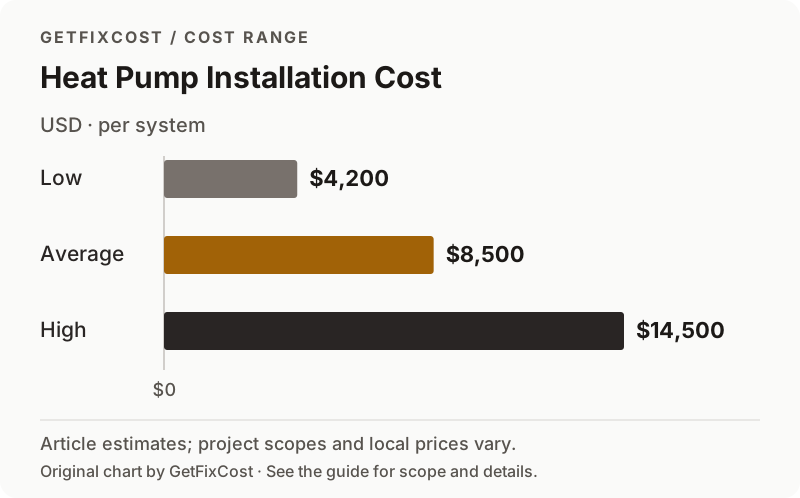
Installing a residential heat pump in the United States typically costs between $4,200 and $14,500, with the national average centering at $8,500 for a standard 3-ton high-efficiency air-source system fully installed.
A standard replacement connecting to existing ductwork in a moderate climate zone starts between $4,200 and $6,500. In contrast, premium cold-climate inverter systems, multi-zone ductless mini-split configurations, or geothermal ground-source systems requiring extensive electrical upgrades range from $9,500 to $18,000+ before tax incentives.
Heat pumps are rapidly superseding conventional furnace and air conditioning combinations across the US. Because heat pumps move heat rather than generate it by burning fossil fuels, they deliver up to 3 to 4 times more thermal energy than the electrical energy they consume, drastically lowering utility bills and household carbon footprints.
Quick-Reference Cost Table
| Heat Pump System Type | Average Installed Cost | Efficiency Range | Climate Suitability | Net Cost After $2,000 Tax Credit |
|---|---|---|---|---|
| Standard Ducted Air-Source | $4,500 – $7,500 | 15 – 17 SEER2 / 8.5 HSPF2 | Moderate / Southern Climates | $3,150 – $5,500 |
| Cold-Climate Ducted Heat Pump | $7,000 – $12,500 | 18 – 22 SEER2 / 10+ HSPF2 | Northern & Sub-Zero Climates | $5,000 – $10,500 |
| Ductless Mini-Split (Single Zone) | $2,800 – $5,200 | 20 – 28 SEER2 / 11+ HSPF2 | Room additions, sunrooms, basements | $1,960 – $3,640 |
| Multi-Zone Mini-Split (3–4 Zones) | $8,500 – $16,000 | 18 – 24 SEER2 / 10+ HSPF2 | Whole-home homes without ducts | $6,500 – $14,000 |
| Dual-Fuel Hybrid System | $8,000 – $13,500 | 16 – 20 SEER2 / Gas Backup | Extreme cold with existing gas service | $6,000 – $11,500 |
Cost Factors That Impact Total Pricing
The final investment for a heat pump installation is shaped by several technical elements:
- System Tonnage & Sizing: Residential heat pumps range from 1.5 to 5 tons (18,000 to 60,000 BTUs). Undersizing leads to cold rooms in winter, while oversizing causes short cycling and poor summer humidity control.
- Inverter vs. Single-Stage Compressor: Single-stage units run at 100% capacity or off. Variable-capacity inverter compressors ramp up and down in 1% increments, operating quietly and maintaining heating down to -15°F, but adding $1,500 to $3,000 to equipment costs.
- Ductwork Condition: Connecting to existing ductwork is cost-effective, but leaks or undersized returns must be sealed and modified ($400 to $1,500) to maintain required airflow.
- Electrical Panel Capacity: Heat pumps equipped with auxiliary electric heat strips (for emergency backup in extreme cold) often require a 50A to 60A circuit breaker, which may necessitate an electrical panel upgrade ($1,500 to $3,000).
- Refrigerant Line Set: Replacing or chemically flushing existing copper line sets to accommodate modern R-410A or A2L refrigerants adds $350 to $900.
Regional Cost Variations Across the US
Climate demands and local incentives heavily influence heat pump project economics:
- Pacific Northwest (WA, OR): Moderate maritime winters and low electric rates make heat pumps the dominant choice. Utility rebates and installer experience keep costs around $7,500 to $12,000.
- Northeast (NY, MA, VT, ME): Aggressive state clean heat rebate programs (often $2,000–$8,000 in direct rebates) offset cold-climate inverter equipment costs of $9,000 to $15,500.
- Midwest (IL, OH, MI): High reliance on natural gas infrastructure makes dual-fuel hybrid heat pumps popular, averaging $7,800 to $13,000.
- South & Southeast (FL, TX, NC): Mild winter conditions favor standard ducted air-source models, keeping average installations competitive at $4,500 to $7,800.
Repair vs. Replace: How to Decide
Determine whether to fix your current HVAC setup or convert to a modern heat pump:
- When to Convert from Oil or Propane: If you currently heat your home with expensive heating oil or delivered propane, converting to a heat pump pays for itself in fuel savings within 3 to 5 heating seasons.
- When to Convert from Central AC: If your central air conditioner is over 12 years old and failing, upgrading to a heat pump instead of a straight AC unit costs only $800 to $1,500 more upfront, while providing supplemental winter heating.
- The 50% Rule: If major compressor or coil repairs on an existing system exceed 50% of the cost of a modern heat pump, replace it to capture the $2,000 federal tax credit and fresh 10-year warranty.
DIY vs. Hiring a Professional & Safety Warnings
While pre-charged DIY mini-split kits (like MrCool) exist for workshops and garages, whole-home ducted heat pump installation requires certified HVAC professionals.
Handling pressurized refrigerants requires EPA Section 608 certification under the federal Clean Air Act. High-voltage 240-volt electrical connections and backup auxiliary heat strips present severe fire and electrocution hazards if wired with improper gauge wire or loose lugs.
Professional HVAC technicians perform ACCA Manual J load calculations, braze copper line sets with nitrogen purging to prevent copper slag from ruining inverter compressors, pull 500-micron deep vacuums, and set precise refrigerant subcooling levels for peak seasonal efficiency.
Warning Signs You Need Action Immediately
Watch for these indicators that your heating and cooling equipment requires replacement:
- Auxiliary Heat Strips Constantly Running: If your thermostat indicates “AUX Heat” or “Emergency Heat” during mild 35°F weather, your compressor or reversing valve has failed.
- Ice Enclosing Outdoor Unit in Winter: A light frost during winter is normal and cleared by defrost cycles. Heavy solid ice encasing the outdoor coil indicates failed defrost control boards or low refrigerant.
- Skyrocketing Winter Electric Bills: Inefficient electric baseboard or failing heat pumps consume massive wattage to maintain modest indoor temperatures.
- Inconsistent Room Temperatures: Severe hot and cold spots between rooms indicate undersized ductwork or poor compressor modulation.
- Frequent Reversing Valve Clicking: If the outdoor unit makes loud hissing or grinding noises when switching between heating and cooling, the valve is sticking.
Hidden Costs & Contractor Pitfalls
Scrutinize heat pump quotes to verify these commonly overlooked expenses:
- Cold-Climate Snow Stands: In northern snow zones, outdoor heat pumps must be elevated 12 to 24 inches on metal riser stands to keep coils above snowdrifts, adding $150 to $350.
- Condensate Drain Freeze Protection: Heat pumps produce gallons of water during winter defrost cycles. Installing heat-tape freeze protection on drain pipes costs $100 to $250.
- Smart Thermostat Integration: Communicating variable-speed inverter systems often require proprietary smart thermostats ($250 to $600) to unlock full efficiency.
- Permit & HERS Testing: Local building codes require mechanical permits and duct leakage testing, adding $200 to $500.
How to Save Money and Vet Contractors
Maximize your heat pump investment with these proven strategies:
- Claim the 25C Federal Tax Credit: Verify the proposed model meets the Consortium for Energy Efficiency (CEE) highest tier to claim the 30% tax credit up to $2,000.
- Stack Electric Utility Rebates: Many electric utilities provide cash rebates ranging from $500 to $3,000 for replacing fossil fuel heating with clean electric heat pumps.
- Insist on an ACCA Manual J Sizing: Never accept a contractor sizing the unit purely on square footage. Precise heat-loss calculations prevent buying excess tonnage.
- Obtain Three Itemized Bids: Require each bid to specify equipment model numbers, SEER2 and HSPF2 ratings, warranty duration, and permit fees.
Typical Project Timeline & Process
A professional residential heat pump installation proceeds as follows:
- Phase 1: Home Load Assessment & Permitting (1 to 2 Weeks): The technician measures rooms, insulation, and windows, calculates heat loads, and pulls mechanical permits.
- Phase 2: Removal & Mechanical Setup (Day 1): Existing indoor furnace/air handler and outdoor condenser are decommissioned and removed. The new outdoor unit is mounted on an elevated pad.
- Phase 3: Line Sets & Wiring (Day 2): Copper lines are brazed, electrical disconnects and thermostat wiring are connected, and the system is evacuated with a vacuum pump.
- Phase 4: Commissioning & Testing (Day 2 Afternoon): Refrigerant is released, airflow CFM is verified, defrost cycles are tested, and homeowner thermostat training is completed. zero weather?** Yes, modern cold-climate inverter heat pumps operate effectively down to -15°F without backup heat strips.
- How long does a heat pump last? With annual maintenance, an air-source heat pump lasts 15 to 20 years.
- Is a heat pump cheaper to run than gas? In regions with moderate electric rates or when replacing propane, fuel oil, or electric baseboards, heat pumps offer major operating savings.
- What is the difference between SEER2 and HSPF2? SEER2 measures cooling efficiency in summer, while HSPF2 measures heating efficiency in winter.
Next Steps & Estimate Checklist
Before scheduling contractor visits, complete these simple steps:
- Check your electrical panel to see if you have open 240V breaker capacity for heat pump equipment.
- Research available state and local utility clean heat incentives to stack with federal tax credits.
- Request itemized written proposals from three licensed HVAC contractors with verified heat pump installation experience.
Frequently Asked Questions
01. How much does a heat pump cost to install on average?
02. What is the federal tax credit for heat pumps?
03. Do heat pumps work in freezing cold climates?
04. What is the difference between a heat pump and central air conditioning?
05. How much can a heat pump save on heating bills?
Related Cost Guides
More in this trade →
Central AC Replacement Cost
Find out what central AC replacement costs, including unit prices, installation labor, and regional variations across the US.
Furnace Replacement Cost
Learn furnace replacement costs by efficiency rating, fuel type, and system size for residential heating systems.
Repair or Replace AC: How to Decide
Learn when to repair versus replace your AC unit, including cost comparisons and system lifespan considerations.