Project Overview & Direct Cost Answer
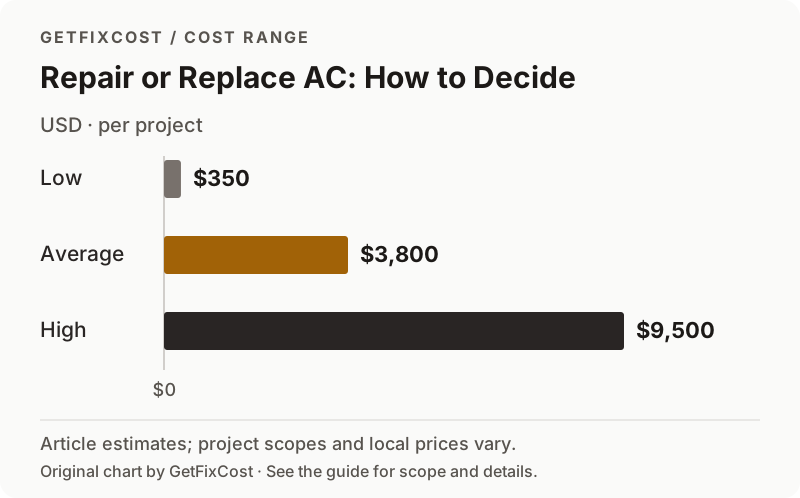
When your central air conditioning system malfunctions during the peak of summer, deciding whether to repair or replace hinges on the system age, the nature of the breakdown, refrigerant type, and the $5,000 Rule.
Minor AC repairs—such as replacing a failed run capacitor, cleaning a clogged condensate drain line, or installing a new contactor—typically cost between $200 and $600. Major mechanical failures, such as replacing a seized compressor or fixing a leaking evaporator coil, range from $1,400 to $3,200. In contrast, a brand-new high-efficiency central AC system runs $4,500 to $9,500 fully installed.
If your air conditioner is under 10 years old, utilizes modern R-410A refrigerant, and faces an electrical or minor mechanical failure, repairing the system is clearly the most economical choice. However, if the unit has surpassed 12 to 15 years of continuous service, still relies on phased-out R-22 Freon, or suffers from repeated compressor lockups, replacing the system delivers immediate energy savings of 20% to 40% on monthly electric bills while eliminating emergency service calls.
Quick-Reference Cost Table
| Component or Service Scope | Average Repair Cost | Lifespan Expectation | Typical Warranty Coverage | Strategic Recommendation |
|---|---|---|---|---|
| Capacitor / Contactor Replacement | $180 – $350 | 5 – 8 Years | 1 Year Parts & Labor | Always repair on systems of any age |
| Condenser Fan Motor Replacement | $400 – $750 | 5 – 10 Years | 1 Year Parts & Labor | Repair if unit is under 12 years old |
| Condensate Drain Line Clearing | $150 – $300 | 1 – 3 Years | 30 – 90 Days | Standard routine maintenance repair |
| Evaporator Coil Replacement | $1,200 – $2,400 | 8 – 12 Years | 5 – 10 Years | Replace if under warranty; replace full system if old |
| Hermetic Compressor Replacement | $1,500 – $2,800 | 8 – 12 Years | 5 – 10 Years | Replace compressor only if covered under warranty |
| Complete System Replacement (SEER2) | $4,500 – $9,500 | 15 – 20 Years | 10 Years Parts & Compressor | Recommended if unit is >12 years or uses R-22 |
Cost Factors That Impact Total Pricing
The cost of addressing a failing air conditioning system is shaped by several technical elements:
- Refrigerant Type (R-22 vs. R-410A vs. A2L): If your system was installed prior to 2010, it likely uses R-22 Freon. Since the EPA banned R-22 production, recharging a leaking 3-ton system can cost $800 to $1,800 in refrigerant alone, with zero guarantee against future leaks.
- SEER2 Efficiency Ratings: Modern standards require higher SEER2 minimums. High-efficiency 16 to 18 SEER2 units require compatible indoor air handlers and expansion valves to achieve published efficiency ratings.
- Line-Set Flushing or Replacement: When converting an older system to modern refrigerants, the copper line set must be chemically flushed or replaced ($400 to $1,200) to eliminate mineral oil residue.
- Electrical Disconnect and Whip: Local electrical codes require a weatherproof outdoor disconnect box and flexible metallic conduit whip, adding $150 to $350.
- Ductwork Capacity: Modern blowers require adequate supply and return duct sizing. Undersized or leaking ducts require sheet metal transitions, adding $300 to $1,000.
Regional Cost Variations Across the US
Cooling demands and labor rates vary significantly across different US climate zones:
- Southern Sunbelt (FL, TX, AZ): High runtime (2,500+ cooling hours annually) accelerates wear, meaning units often fail around 10 to 12 years. High local competition keeps standard replacements around $4,200 to $8,000.
- Mid-Atlantic & Midwest: Moderate summer cooling seasons extend AC lifespans to 15–18 years. Combined furnace and AC split system replacements average $7,500 to $13,000.
- West Coast & Southwest: High regulatory standards (Title 24 duct leakage testing) and elevated HVAC technician labor rates place replacements at $5,500 to $10,500.
- Northeast: Older basements and tight attic air-handler installations increase installation labor, with average costs running $5,200 to $9,800.
Repair vs. Replace: How to Decide
Homeowners should rely on these mathematical and technical benchmarks:
- The $5,000 Rule: Multiply the age of your air conditioning equipment (in years) by the total written repair estimate. If the product exceeds $5,000, replacement is the smarter long-term financial move. For example, a 10-year-old AC needing an $800 blower motor equals $8,000—indicating you should replace. Conversely, an 8-year-old unit needing a $250 capacitor equals $2,000—indicating you should repair.
- The 50% Rule: If the proposed repair invoice equals or exceeds 50% of the cost of a brand-new outdoor condenser, replace the system immediately.
- Frequent Refrigerant Recharging: An air conditioner is a hermetically sealed closed loop; it does not consume refrigerant. If a technician tells you your system needs annual top-offs, you have an active leak. Paying $500 annually for top-offs is a waste of money compared to replacing the failing coil.
- Manufacturer Warranty Coverage: Check your outdoor unit label for the serial number. Most major brands provide 10-year parts warranties if registered upon installation.
DIY vs. Hiring a Professional & Safety Warnings
Homeowners can safely tackle basic air conditioning maintenance like changing 1-inch pleated air filters every 60 days, washing outdoor condenser leaves with a low-pressure garden hose, and pouring a cup of white vinegar down the condensate drain line to prevent algae buildup.
However, all internal mechanical and electrical repairs require an EPA-certified, licensed HVAC technician.
Under Section 608 of the Federal Clean Air Act, it is illegal for anyone without EPA certification to buy, handle, or vent refrigerants into the atmosphere. Furthermore, the dual-run capacitor inside your AC disconnect panel stores high-voltage electrical energy (up to 440 volts) even when the main breaker is switched off, presenting serious shock hazards.
Warning Signs You Need Action Immediately
Look out for these clear indicators that your cooling system is reaching a critical failure point:
- Warm Air from Supply Registers: If your thermostat calls for cooling but registers blow room-temperature air, either the compressor has locked up, the capacitor has failed, or refrigerant has leaked.
- Ice Forming on Copper Lines: Ice accumulation on the indoor coil or outdoor suction line indicates severely restricted airflow (clogged filter) or low refrigerant levels caused by a coil leak.
- Grinding or Squealing Noises: Loud metal-on-metal noises indicate worn motor bearings or broken compressor valves that risk seizing.
- Unexplained Spikes in Electric Bills: An aging compressor with worn internal seals must run twice as long to achieve the same cooling capacity, causing sharp increases in summer bills.
- Water Pooling Around Indoor Air Handler: A cracked evaporator drain pan or blocked drain line can overflow, causing serious water damage to ceilings and floors.
Hidden Costs & Contractor Pitfalls
Watch for these common extra fees in HVAC contractor proposals:
- Mismatched Evaporator Coils: Replacing only the outdoor unit with a modern condenser while leaving an old indoor coil creates mismatched expansion ratios and rapid compressor burnout. Both components should be replaced together.
- Refrigerant Line-Set Sizing: Modern R-410A systems often require different diameter lines than older R-22 equipment. Running new line sets through finished walls adds $500 to $1,500.
- Safety Float Switches: Building codes require secondary drain pans with automated float switches that shut off the AC if water backs up, adding $150 to $300.
- Mechanical Permits: HVAC replacements require municipal mechanical permits and post-installation inspections, running $100 to $350.
How to Save Money and Vet Contractors
Ensure fair pricing and top-tier installation quality with these strategies:
- Obtain Manual J Load Calculations: Never allow a contractor to size your replacement AC unit based solely on home square footage. Insist on an ACCA Manual J calculation that accounts for window orientation, insulation, and ceiling heights.
- Leverage Federal IRA Tax Credits: The Inflation Reduction Act provides federal tax credits up to $2,000 for qualified heat pumps and up to $600 for high-efficiency central AC units meeting CEE Tier 1 standards.
- Compare Off-Season Pricing: Replacing your cooling system during the mild spring or fall often secures 10% to 15% promotional rebates from contractors seeking off-peak volume.
- Require Itemized Quotes: Ensure every bid lists the exact equipment model numbers for both the outdoor condenser and indoor air handler/coil, warranty terms, and permit fees.
Typical Project Timeline & Process
Here is the typical schedule for an AC service call or full system replacement:
- Phase 1: Diagnostic Service Call (1 to 2 Hours): The technician measures electrical voltage, checks capacitor microfarads, inspects coils, and connects gauges to test refrigerant subcooling and superheat.
- Phase 2: Repair Execution (1 to 4 Hours): If repairing, parts on the technician’s truck (capacitors, contactors, fan motors) are swapped out immediately. Specialty coils or compressors may take 2 to 5 days to arrive.
- Phase 3: Full Replacement Installation (1 Full Workday): For a complete system changeout, a two-person crew recovers old refrigerant, uninstalls old equipment, sets the new condenser on a level pad, brazes copper lines, pulls a 500-micron deep vacuum, and releases the refrigerant charge.
- Phase 4: Commissioning & Quality Check (1 Hour): Technicians verify temperature split across supply and return ducts (typically 16°F to 22°F) and configure your digital programmable thermostat.
Next Steps & Estimate Checklist
Before committing to a high-ticket AC repair or replacement proposal:
- Check your outdoor unit’s data plate for the manufacturing date and model number to determine warranty status.
- Request written, itemized repair vs replacement quotes from at least three licensed HVAC contractors.
- Ask contractors whether federal energy tax credits or local electric utility rebates apply to the proposed equipment.
- Verify that your installation contract includes a minimum 1-year labor guarantee and 10-year equipment warranty.
Frequently Asked Questions
01. What is the $5,000 rule for air conditioner replacement?
02. Is it worth replacing a compressor on a 10-year-old AC unit?
03. Can I replace just the outdoor AC condenser and keep my old indoor evaporator coil?
04. How long does a central air conditioner typically last in the US?
05. Why is R-22 Freon refrigerant so expensive to recharge?
Related Cost Guides
More in this trade →
Central AC Replacement Cost
Find out what central AC replacement costs, including unit prices, installation labor, and regional variations across the US.
Furnace Replacement Cost
Learn furnace replacement costs by efficiency rating, fuel type, and system size for residential heating systems.
Heat Pump Installation Cost
Find out heat pump installation costs for ducted and mini-split systems, including labor and refrigerant line work.