Project Overview & Direct Cost Answer
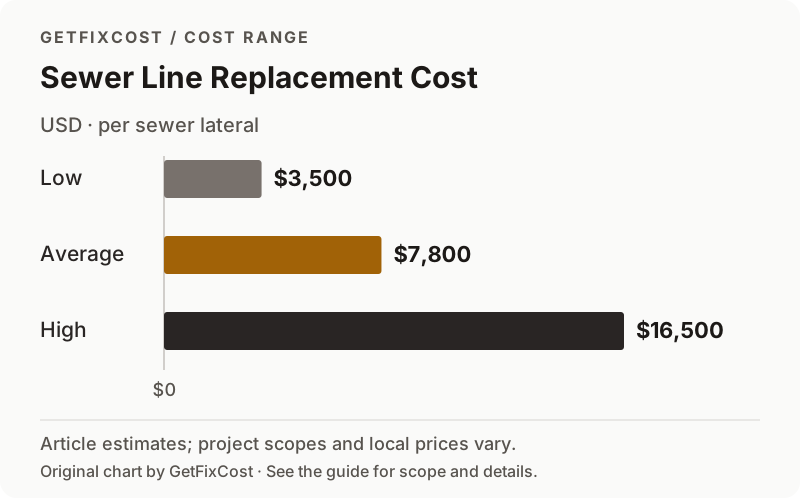
Replacing a residential main sewer line in the United States typically costs between $3,500 and $16,500, with the national average sitting at $7,800 for a complete 50-foot lateral replacement from the foundation to the municipal sewer tie-in.
Per-foot costs average $50 to $200 per linear foot, depending on whether your plumber uses traditional open-trench excavation or modern trenchless methods. Straightforward shallow digs across an open lawn start around $3,500 to $5,500. Conversely, complex jobs involving cutting through concrete driveways, excavating past 8-foot depths, or trenching into municipal streets with city traffic control permits can reach $12,000 to $25,000.
Your main sewer lateral is your home’s most vital drainage artery. When older clay, cast iron, or Orangeburg pipes succumb to tree roots, soil shifting, or internal corrosion, sewage backs up into basement floor drains and bathtubs. Modern replacement with seamless Schedule 40 PVC or high-density polyethylene (HDPE) provides 50 to 100 years of root-proof drainage.
Quick-Reference Cost Table
| Replacement Method | Cost Per Linear Foot | Typical 50-Foot Total | Excavation Impact | Ideal Household Scenario |
|---|---|---|---|---|
| Traditional Open-Trench Dig | $50 – $125 | $3,500 – $7,500 | High (trenches lawn & landscape) | Open front yards with shallow sewer lines |
| Trenchless Pipe Bursting | $80 – $180 | $5,000 – $9,500 | Low (requires 2 small access pits) | Under mature trees, patios, or driveways |
| Cured-in-Place Pipe Lining (CIPP) | $90 – $220 | $6,000 – $11,500 | Minimal (uses existing cleanout) | Pipes with structural integrity, light cracks |
| Street & City Main Tie-In | $150 – $350 | $8,500 – $18,000 | Very High (cuts asphalt roadway) | Collapsed sewer pipe under public street |
| Spot Section Repair (10–15 Ft) | $120 – $250 | $1,800 – $3,800 | Moderate (localized excavation) | Isolated tree root blockage or localized break |
Cost Factors That Impact Total Pricing
The final expense of a sewer line replacement depends on several subterranean and surface variables:
- Pipe Depth & Distance: Sewer pipes sloped at 1/4-inch per foot can sit 3 feet deep near the house foundation but plunge 8 to 12 feet deep near the street main. Excavating beyond 5 feet requires OSHA-mandated trench shoring boxes, significantly increasing labor time and equipment rental costs.
- Trenchless vs. Open Excavation: While trenchless pipe bursting costs slightly more per linear foot in pure plumbing equipment, it often saves $2,000 to $5,000 in restored landscaping, sod, stamped concrete, and asphalt driveway repair.
- Location of Pipe Obstructions: Running under pristine lawns is inexpensive. Running beneath concrete walkways, asphalt driveways, retaining walls, or brick paver patios requires concrete cutting, backhoe hydraulic breakers, and surface reconstruction.
- Street Opening & Traffic Control: If the collapse occurs under the public street or sidewalk, contractors must obtain municipal right-of-way permits, hire off-duty police or certified flaggers for traffic control, and pay asphalt repaving fees, adding $2,500 to $7,000.
- Exterior Cleanout Installation: Modern plumbing codes require a dual two-way exterior sewer cleanout at ground level. If your older home lacks one, installing cleanout risers adds $800 to $1,800.
Regional Cost Variations Across the US
Geographic soil types, frost lines, and municipal permitting influence plumbing bids:
- Northeast (NY, MA, PA): Deep frost lines require sewer lines to sit 6 to 10 feet below grade. Rocky soils and older historic street infrastructure raise replacements to $8,500 to $16,500.
- West Coast (CA, WA, OR): High prevailing union plumbing wages ($120–$180/hr) and strict municipal environmental inspection mandates average $8,000 to $15,000.
- Midwest (IL, OH, MI): Sandy loam and clay soils with moderate frost lines keep standard replacements around $5,500 to $9,500.
- South & Sunbelt (TX, FL, GA): Shallow frost depths (2 to 4 feet deep) allow rapid mini-excavator digging, keeping average costs lower at $4,500 to $8,000.
Repair vs. Replace: How to Decide
Consult high-definition sewer camera inspection footage to make your decision:
- When to Hydro-Jet or Spot Repair: If your sewer line is modern PVC or structurally sound cast iron, and camera footage reveals localized tree root intrusion through a single joint, hydro-jetting ($350 to $750) or an isolated 10-foot spot patch ($1,800 to $3,200) is completely appropriate.
- When to Replace Completely: If camera inspection reveals severe pipe “bellies” (low spots holding standing water), extensive pipe wall collapse, rotten Orangeburg bituminized fiber pipes, or corroded cast iron channeling along the pipe bottom, spot repairs will fail within months.
- The 50% Rule: If recurring drain clearing and rooter service bills exceed $800 to $1,200 annually, or if a localized repair quote exceeds half the price of trenchless pipe bursting, replace the entire lateral.
DIY vs. Hiring a Professional & Safety Warnings
Sewer lateral replacement is strictly a project for licensed master plumbers and specialized excavation contractors.
Trench collapses represent an immediate, fatal suffocation hazard; a single cubic yard of soil weighs roughly 2,700 pounds (as much as an automobile). Federal OSHA safety regulations require trench boxes or slope-stepping for excavations over 5 feet deep. Furthermore, underground excavations risk striking high-pressure natural gas lines, buried electrical conduits, or fiber optic cables.
Professional sewer contractors coordinate with 811 utility locating services, possess optical transit levels to verify essential 1/4-inch-per-foot downward slope, and coordinate required municipal plumbing inspections before backfilling trenches.
Warning Signs You Need Action Immediately
Watch for these definitive symptoms of a failing sewer lateral:
- Multiple Slow or Backing Up Drains: If toilets, bathtubs, and sinks back up simultaneously across the lowest level of your home, the main lateral is blocked.
- Gurgling Sounds from Toilets: Gurgling noises from toilet bowls when running the washing machine or shower indicate sewer line air displacement caused by a partial obstruction.
- Sewer Gas Odors in Yard or Basement: A rotten egg or sewage smell in your yard or basement signals a cracked sewer pipe leaking sewer gas and waste.
- Indented or Lush Green Patches in Lawn: Unusually green, fast-growing grass patches or soggy sinkholes in your front lawn indicate underground sewage fertilization from a cracked pipe.
- Sewage Backing Up into Floor Drains: Raw sewage pooling around basement floor drains during heavy rain demands immediate emergency plumbing response.
Hidden Costs & Contractor Pitfalls
Review sewer replacement proposals carefully to identify these common exclusions:
- Landscape and Driveway Restoration: Plumbing contractors excavate and backfill trenches, but repaving asphalt driveways, pouring concrete walkways, and re-sodding lawns is usually excluded, adding $1,000 to $4,000.
- City Street Bond & Inspection Fees: Municipal street-opening permits often require refundable contractor performance bonds and permit fees totaling $500 to $1,500.
- Utility Line Conflict Reroutes: Water or gas lines crossing perpendicular to the sewer ditch may require manual hand-digging, adding $300 to $700 in labor.
- Mandatory Cleanout Additions: Installing two-way code-mandated exterior cleanouts adds $800 to $1,500 if not already itemized.
How to Save Money and Vet Contractors
Protect your budget during an emergency sewer breakdown with these steps:
- Get an Unedited Video Camera Inspection: Always request a digital copy (USB or cloud link) of the sewer camera inspection. Verify the camera head footage clearly shows the distance counter and true pipe collapse before approving replacement.
- Compare Trenchless Pipe Bursting Bids: Ask contractors specifically for trenchless bursting options. Avoiding lawn, driveway, and porch destruction often makes trenchless cheaper overall.
- Check Service Line Protection Coverage: Check your homeowners insurance policy or local water utility bills. Many homeowners have optional service line warranty endorsements that pay up to $10,000 for sewer replacement.
- Obtain Three Written Bids: Even in emergencies, calling three licensed plumbing companies can reveal pricing differences of $3,000 to $6,000 for the exact same lateral run.
Typical Project Timeline & Process
A residential sewer lateral replacement generally proceeds as follows:
- Phase 1: Video Inspection & 811 Locates (Day 1): The plumber runs a high-resolution camera, marks pipe depth, and calls 811 utility locators to spray-paint gas, electric, and water lines.
- Phase 2: Permitting (Days 2 to 4): Municipal building permits and excavation authorizations are secured.
- Phase 3: Excavation or Pipe Bursting (Days 5 to 6): For trenchless bursting, small launch and receiving pits are dug, and a hydraulic winch pulls seamless HDPE pipe through the old line. For traditional digging, a backhoe trenches the path.
- Phase 4: Inspection & Backfill (Day 7): The city plumbing inspector witnesses a water head or air pressure test, approves the pipe grade, and the trench is mechanically backfilled and compacted.
Next Steps & Estimate Checklist
Before signing an emergency sewer replacement contract:
- Request a digital copy of the sewer camera video inspection showing the exact point of failure.
- Inquire whether your homeowner policy or water utility offers service line protection coverage.
- Get at least two or three written quotes comparing open-trench versus trenchless pipe bursting options.
Frequently Asked Questions
01. How much does it cost to replace a sewer line on average?
02. How much does sewer line replacement cost per foot?
03. What is trenchless sewer line replacement?
04. Who is responsible for the sewer line from the house to the street?
05. Does homeowners insurance cover sewer line replacement?
Related Cost Guides
More in this trade →
Water Heater Repair or Replace: Decision Guide
Learn when to repair versus replace your water heater, including cost thresholds and age-based decision rules.
Water Heater Replacement Cost
Find out water heater replacement costs for tank and tankless models, including gas and electric installation.
Whole House Repiping Cost
Understand whole-house repiping costs for copper, PEX, and CPVC pipe materials, including labor and wall repairs.