Project Overview & Direct Cost Answer
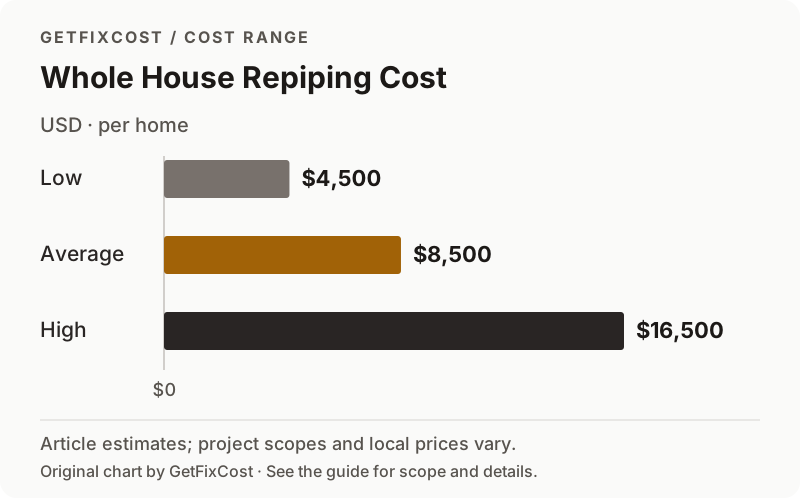
Completely repiping a residential home in the United States typically costs between $4,500 and $16,500, with the national average centering at $8,500 for a standard 2 to 3-bathroom single-family home using modern PEX tubing.
Costs range from $2,000 to $4,500 per bathroom fixture group. A modest single-story ranch home with an open crawl space or unfinished basement using flexible PEX-A tubing can cost as little as $4,500 to $6,500. Conversely, a large multi-story home with 4+ bathrooms, rigid copper piping throughout, concrete slab foundations, and high-end tile enclosures frequently reaches $12,000 to $22,000+ when drywall and tile repairs are included.
Replacing older galvanized steel or defective polybutylene plumbing lines with modern PEX or Type L copper restores high water pressure, eliminates yellow or rust-tinted drinking water, eliminates sudden pinhole pipe leaks inside walls, and protects your home against catastrophic water damage claims.
Quick-Reference Cost Table
| Home Size & Bathroom Count | PEX Repiping Cost | Rigid Copper Repiping Cost | Plumbing Labor Time | Wall Cutouts Required |
|---|---|---|---|---|
| Small Home (1–1.5 Baths, 1-Story) | $3,500 – $6,000 | $6,000 – $10,500 | 2 – 3 Days | 8 – 15 Cutouts |
| Medium Home (2–2.5 Baths, 2-Story) | $6,500 – $10,500 | $10,000 – $16,500 | 3 – 4 Days | 15 – 30 Cutouts |
| Large Home (3–4 Baths, 2-3 Stories) | $9,500 – $16,500 | $15,000 – $24,000 | 4 – 7 Days | 30 – 50 Cutouts |
| Slab Foundation Overhead Reroute | $7,500 – $13,500 | $12,000 – $19,000 | 3 – 5 Days | Ceiling & Attic Routing |
| Turnkey Drywall Patching & Paint | $1,200 – $2,800 (Add-On) | $1,800 – $3,500 (Add-On) | 2 – 3 Days | Patches all access holes |
Cost Factors That Impact Total Pricing
Several crucial factors determine your total whole-house repiping estimate:
- Pipe Material (PEX vs. Copper): PEX-A and PEX-B tubing costs 35% to 50% less than Type L rigid copper pipe. Because PEX is flexible and can be snaked through wall cavities like electrical cable, it requires 60% fewer wall cutouts and zero soldering torches.
- Foundation Type (Crawl Space vs. Slab vs. Basement): Homes built over accessible basements or crawl spaces allow plumbers to run main water trunks openly along floor joists ($4,500–$8,000). Homes on concrete slabs require either cutting into concrete foundations or rerouting all lines overhead through the attic and ceiling bays ($7,500–$14,000).
- Number of Plumbing Fixtures: Plumbers tally every hot and cold connection: sinks, toilets, showers, bathtubs, hose bibbs, washing machines, water heaters, and refrigerator ice makers. More fixtures require larger distribution manifolds.
- Drywall & Tile Restoration: Plumbers must cut 4x4-inch or 8x8-inch access holes in drywall to reach shower valves and stub-outs. Turnkey repiping contractors include professional drywall patching and texture matching in their bids; others leave holes for homeowners to handle.
- Main Water Shutoff & Pressure Regulator (PRV): Replacing the main water shutoff ball valve and installing a new pressure reducing valve (PRV) adds $300 to $700.
Regional Cost Variations Across the US
Plumbing wages and municipal permitting fees vary across different US regions:
- West Coast (CA, WA, OR): High licensed plumber wages ($120–$180/hr) and strict seismic strapping standards place typical PEX repiping at $8,500 to $15,000.
- Northeast (NY, MA, PA): Older multi-story colonial homes with plaster walls and difficult pipe chase access average $8,000 to $14,500.
- Midwest (IL, OH, MI): Readily accessible basement utility rooms and competitive plumbing markets keep standard installations around $5,500 to $9,500.
- South & Sunbelt (TX, FL, GA): Widespread slab-on-grade construction makes overhead attic reroutes standard, averaging $6,500 to $11,500.
Repair vs. Replace: How to Decide
Determine whether spot pipe repairs or complete whole-home repiping is warranted:
- When to Spot Repair: If your home has modern copper or PEX lines and experiences an isolated pinhole leak or frozen burst pipe in an exterior wall, repairing the localized pipe section for $250 to $600 is completely appropriate.
- When to Repipe Completely: If your home was built before 1970 and contains original galvanized steel pipes, or was built between 1978 and 1995 with defective polybutylene (Quest) plastic pipe that is prone to sudden joint fracture, whole-home repiping is essential.
- The Multiple Leak Rule: If you have experienced two or more pipe leaks within a 12-month period, your plumbing system has reached systematic metal fatigue. Repeated emergency insurance claims risk policy cancellation or doubled deductibles.
DIY vs. Hiring a Professional & Safety Warnings
While repairing a single PEX joint under a kitchen sink using crimp rings is an accessible DIY task, whole-house repiping requires a licensed master plumbing contractor.
Improperly installed water pipes under 60 to 80 PSI of constant municipal water pressure will cause catastrophic flooding if a single fitting slips. Furthermore, cutting wall studs and joists to run pipes without adhering to structural building codes (IRC Chapter 3) compromises the structural integrity of your home’s load-bearing framing.
Licensed plumbers carry master licenses and $1,000,000+ in liability insurance, size distribution lines to prevent fixture pressure drops when toilets flush, pull required municipal permits, and coordinate air-pressure testing with city building inspectors.
Warning Signs You Need Action Immediately
Watch for these definitive indicators of systemic pipe failure:
- Low Water Pressure Across Multiple Fixtures: Indicates heavy mineral scale and rust buildup inside galvanized pipes, choking 3/4-inch pipes down to pencil-thin openings.
- Discolored Brown or Yellow Water: Rust flakes leaching into water lines when fixtures are turned on after hours of disuse indicate advanced pipe oxidation.
- Recurring Pinhole Leaks in Walls: Green corrosion spots on copper or wet baseboards indicate systemic pinhole pitting from acidic water chemistry.
- Polybutylene Pipe Present: Grey plastic pipe stamped “PB2110” is notoriously brittle and uninsurable by most major property insurance carriers.
- Squealing or Banging Pipes (Water Hammer): Unsecured pipes knocking against framing joists when valves shut off rapidly.
Hidden Costs & Contractor Pitfalls
Carefully examine repiping bids for these frequently omitted items:
- Drywall Patching & Painting: Verify whether the bid is “plumbing only” or “turnkey” including drywall repair. Repainting entire rooms after patching adds $1,000 to $2,500.
- Shower Valve Replacement: Connecting new PEX pipes to obsolete two-handle shower valves is often impossible; upgrading to modern pressure-balanced single-handle shower valves costs $250 to $500 per bathroom.
- Main Water Service Line from Meter: The contract usually covers indoor plumbing; replacing the underground pipe running from the street water meter to the house foundation adds $1,800 to $3,500.
- Permit & Inspection Fees: Municipal building permits and post-installation pressure tests cost $150 to $350.
How to Save Money and Vet Contractors
Protect your home plumbing budget with these practical guidelines:
- Choose PEX-A Over Rigid Copper: PEX-A expansion tubing (Uponor ProPEX) costs roughly 40% less than copper, will never pinhole-leak from acidic water, and expands up to 300% to resist freezing without splitting.
- Opt for Turnkey Repiping Specialists: Dedicated repiping companies complete installations in 2 days and include professional drywall patching crews, saving thousands over hiring separate general plumbers and drywallers.
- Upgrade Hose Bibbs & Stops Simultaneously: Replace all old quarter-turn shutoff valves, braided supply lines, and outdoor frost-proof sillcocks during the repipe.
- Obtain Three Itemized Bids: Require bids to specify PEX brand, pipe sizing (3/4” trunk lines and 1/2” fixture branches), drywall patching scope, and warranty length (demand 25-year manufacturer warranties).
Typical Project Timeline & Process
A whole-house repiping project proceeds through these typical phases:
- Phase 1: Protection & Staging (Day 1 Morning): Floors are covered with protective plastic, and plumbers cut neat 4x4-inch access squares in drywall near fixture connections.
- Phase 2: Pipe Routing & Rough-In (Days 1 to 2): Main PEX trunk lines are run through basements, attics, and wall cavities; new fixture stub-outs and shower valves are installed.
- Phase 3: Tie-In & Pressure Testing (Day 2 to 3): The new system is connected to the water heater and main line, lines are purged of air, and pressure gauges verify zero leaks under 100 PSI air pressure.
- Phase 4: Inspection & Drywall Patching (Days 4 to 5): The city plumbing inspector approves the work, drywall squares are re-installed, taped, mudded with three coats, textured, and left ready for paint. zed or polybutylene pipes removes major buyer inspection contingencies and lowers insurance premiums.
Next Steps & Estimate Checklist
Before scheduling repiping contractor consultations:
- Count your total plumbing fixtures (bathrooms, kitchen, laundry, hose bibbs).
- Inspect your exposed basement or crawl space pipes and note whether they are copper, galvanized steel, or grey polybutylene.
- Request written itemized proposals from three licensed repiping specialists specifying turnkey drywall restoration.
Frequently Asked Questions
01. How much does it cost to repipe a house on average?
02. Is PEX or copper better for whole-house repiping?
03. How long does a whole-house repipe take?
04. Why do galvanized steel pipes need to be replaced?
05. Does repiping include drywall patching and painting?
Related Cost Guides
More in this trade →
Sewer Line Replacement Cost
Find out sewer line replacement costs for traditional trenching and trenchless pipe bursting methods.
Water Heater Replacement Cost
Find out water heater replacement costs for tank and tankless models, including gas and electric installation.
Water Heater Repair or Replace: Decision Guide
Learn when to repair versus replace your water heater, including cost thresholds and age-based decision rules.