Project Overview & Direct Cost Answer
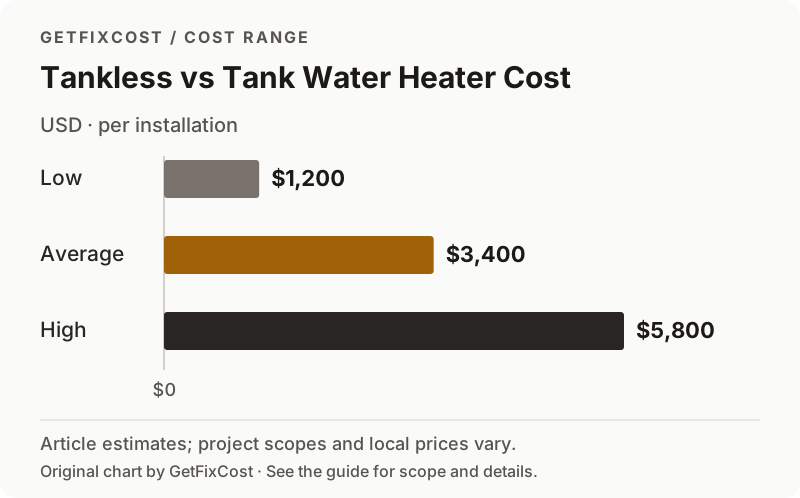
Comparing the cost of tankless versus tank water heaters in the United States reveals a clear financial trade-off: standard tank water heaters cost $1,200 to $2,800 fully installed, while whole-house tankless systems cost $2,800 to $5,800 installed.
The national average to replace a standard 50-gallon tank water heater sits at $1,650, whereas converting to an on-demand tankless unit averages $3,600. The $1,500 to $3,000 price difference is driven primarily by infrastructure modifications: tankless units demand high-capacity gas supply pipes, dedicated Category IV PVC venting, and dedicated electrical outlets.
However, tankless units offer compelling long-term advantages: they deliver endless continuous hot water, eliminate standby thermal energy loss, occupy 80% less space mounted on a wall, and boast a 20 to 25-year lifespan—more than double the 8 to 12-year lifespan of traditional storage tanks.
Quick-Reference Cost Table
| Water Heater Feature | Traditional Storage Tank (50-Gal) | Whole-Home Gas Tankless | Whole-Home Electric Tankless |
|---|---|---|---|
| Initial Installed Cost | $1,200 – $2,800 | $2,800 – $5,500 | $2,200 – $4,200 |
| Average Equipment Lifespan | 8 – 12 Years | 20 – 25+ Years | 15 – 20 Years |
| Annual Fuel / Energy Cost | $300 – $550 / Year | $180 – $380 / Year | $350 – $600 / Year |
| Space Required | 12 – 16 Sq Ft floor footprint | Zero floor space (wall mount) | Zero floor space (compact wall mount) |
| Hot Water Availability | Limited to 50 gallons / recovery | Endless continuous flow | Endless (limited by climate flow rate) |
| Federal Tax Credit (IRA) | Up to $2,000 (Heat Pump Only) | Up to $600 (UEF ≥ 0.95) | None for electric resistance |
Cost Factors That Impact Total Pricing
Converting from a conventional storage tank to a tankless system involves several unique installation costs:
- Gas Line Upsizing: A standard 50-gallon gas tank consumes 40,000 BTUs. An on-demand tankless unit requires 160,000 to 199,000 BTUs to heat cold incoming water instantaneously. Plumbers must often replace 1/2-inch gas piping with 3/4-inch or 1-inch pipe, adding $350 to $900.
- Combustion Air & Venting Upgrades: Tankless units cannot vent into existing metal chimneys. They require dedicated Schedule 40 PVC, CPVC, or polypropylene pipes vented directly through an exterior wall, adding $400 to $1,000.
- Electrical Circuit Installation: Gas tankless heaters require electric power to operate digital control boards and electronic igniters. Installing a dedicated 120V outlet adds $150 to $350.
- Water Hardness & Scale Management: In regions with hard water (over 7 grains per gallon), mineral scale quickly coats copper heat exchangers. Installing an inline scale filter or water softener adds $300 to $1,200.
- Freeze Protection Kits: In cold northern climates, outdoor or unheated basement installations require motorized freeze-protection dampers and pipe insulation heating cables, adding $150 to $300.
Regional Cost Variations Across the US
Groundwater inlet temperature and regional labor rates impact tankless sizing and costs:
- Northern US (IL, NY, MN, WI): Groundwater entering homes in winter can be as cold as 37°F to 42°F. Heating water to 120°F requires a severe 75°F to 80°F temperature rise, necessitating large 199,000 BTU commercial-grade units ($3,500 to $5,800).
- Southern Sunbelt (FL, TX, AZ): Warm groundwater (65°F to 75°F) requires only a modest 45°F rise. Smaller, less expensive tankless units deliver high flow rates easily, averaging $2,500 to $4,200.
- West Coast (CA, WA, OR): High plumbing labor rates ($110–$160/hr) and strict ultra-low NOx gas appliance emissions mandates place average retrofits at $3,400 to $5,500.
- Southeast (GA, NC, SC): Abundant ground-level laundry room access and moderate labor keep standard tankless installations around $2,600 to $4,200.
Repair vs. Replace: How to Decide
Use these practical decision criteria to select the right water heater technology:
- When to Stick with a Standard Tank: If your budget is limited, you plan to sell your home within 3 to 5 years, or your electrical panel/gas supply line cannot support tankless without thousands in heavy-ups, replacing with a standard tank ($1,200 to $2,200) is the sensible financial choice.
- When to Upgrade to Tankless: If you have a large family that frequently runs out of hot water, desire freed-up basement or closet floor space, and plan to stay in the home for at least 7 to 10 years, tankless is an outstanding upgrade.
- The Heat Pump Alternative: If you have an electric home, an electric hybrid heat pump water heater ($2,200 to $3,800 installed) delivers even greater energy savings than electric tankless and qualifies for a $2,000 federal tax credit.
DIY vs. Hiring a Professional & Safety Warnings
While installing an electric point-of-use under-sink heater is manageable for DIYers, installing a whole-home gas tankless water heater requires a licensed master plumber.
Improperly sized gas supply piping causes pressure drops that starve home furnaces, leading to delayed burner ignition and soot accumulation. Furthermore, improper plastic venting materials will melt from exhaust temperatures, releasing lethal carbon monoxide gas into the home.
Licensed plumbers calculate total fixture flow rates (GPM), properly size gas pipe capacity according to the National Fuel Gas Code (NFPA 54), pull required municipal permits, and install essential isolation service valves for annual descaling maintenance.
Warning Signs You Need Action Immediately
Watch for these indicators that your existing water heater is failing:
- Rust-Colored Hot Water: Indicates the sacrificial anode rod has dissolved and the steel tank walls are rusting.
- Rumbling or Popping Sounds: Heavy sediment trapped in a tank water heater boils and bakes the steel bottom, leading to imminent rupture.
- Cold Water Sandwich Effect: In older tankless units, fluctuating water temperatures indicate scale buildup on the flow sensor or heat exchanger.
- Error Codes on Digital Display: Modern tankless units display fault codes indicating ignition failure, blocked exhaust flues, or overheating.
- Water Leaking Around the Base: A leaking storage tank cannot be repaired; shut off the water valve immediately to prevent flooding.
Hidden Costs & Contractor Pitfalls
Be aware of these potential extras when evaluating tankless conversion bids:
- Isolation Service Valves: Service valves allow flushing the heat exchanger with vinegar. If omitted from the estimate, adding them later costs $150 to $300.
- Gas Meter Regulator Upgrades: Gas utilities sometimes charge $100 to $300 to upgrade the exterior gas meter spring regulator to accommodate 200,000 BTU surge draws.
- Dedicated Return Recirculation Line: Waiting for hot water to travel from a tankless unit to distant bathrooms can take 30 to 60 seconds. Adding a built-in recirculation pump and line costs $300 to $700.
- Condensate Neutralizer Kit: High-efficiency condensing tankless units produce acidic condensation that eats cast iron pipes. Adding a limestone neutralizer kit costs $100 to $200.
How to Save Money and Vet Contractors
Protect your budget and ensure premium installation with these tips:
- Claim the $600 Federal 25C Tax Credit: Ensure your gas tankless unit has an Energy Star rating with a UEF of 0.95 or higher to claim the federal tax credit.
- Inquire About Gas Utility Rebates: Many gas utilities offer cash incentives between $200 and $500 for switching to high-efficiency tankless units.
- Perform Annual DIY Descaling: Flushing your tankless unit once a year with 4 gallons of distilled white vinegar and a small submersible pump ($80 DIY kit) saves $200 in annual plumbing maintenance fees.
- Demand Turnkey Proposals: Ensure written bids include all venting, gas line upgrades, electrical work, old tank removal, and municipal permit fees.
Typical Project Timeline & Process
A full tank-to-tankless conversion generally takes one full workday:
- Phase 1: Demolition & Draining (1 to 2 Hours): The old storage tank is drained, gas/water connections are cut, and the heavy tank is removed.
- Phase 2: Mounting & Venting (2 to 4 Hours): The compact tankless cabinet is securely bolted to wall studs, and concentric PVC intake and exhaust pipes are cored through the exterior rim joist.
- Phase 3: Gas & Plumbing Connections (2 to 3 Hours): Upgraded 3/4-inch gas lines, water isolation valves, and condensate drain lines are piped and pressure-tested.
- Phase 4: Commissioning (1 Hour): Water lines are purged of air, gas pressure is tested under full fire, and water temperature is calibrated on the digital interface.
Next Steps & Estimate Checklist
Before committing to a water heater replacement or conversion:
- Check your gas line size (1/2-inch vs 3/4-inch) and inspect your electrical panel for an open 120V circuit.
- Calculate your household peak hot water demand (number of showers and appliances running simultaneously).
- Solicit three comprehensive written estimates comparing standard tank replacement against on-demand tankless conversion.
Frequently Asked Questions
01. How much more does a tankless water heater cost than a tank model?
02. How much money does a tankless water heater save per year?
03. How long does a tankless water heater last compared to a tank?
04. Why is installing a tankless water heater so expensive?
05. Do tankless water heaters qualify for federal tax credits?
Related Cost Guides
More in this trade →
Water Heater Repair or Replace: Decision Guide
Learn when to repair versus replace your water heater, including cost thresholds and age-based decision rules.
Water Heater Replacement Cost
Find out water heater replacement costs for tank and tankless models, including gas and electric installation.
Whole House Repiping Cost
Understand whole-house repiping costs for copper, PEX, and CPVC pipe materials, including labor and wall repairs.